A well-managed Battersea building depends on more than a polished entrance. Consistent maintenance, clear responsibility for shared spaces and...

A well-managed Battersea building depends on more than a polished entrance. Consistent maintenance, clear responsibility for shared spaces and attention to security all contribute to a property that works well day to day. For owners considering facility management battersea, coordinating these responsibilities can be challenging when tasks are split across different stakeholders.
Effective facilities management brings the building’s operational needs into a clearer framework. It helps owners oversee routine upkeep and priorities while supporting a well-maintained, secure and welcoming environment for residents.
This guide explains what facilities management can cover in Battersea, how it differs from block and residence management, and how to set practical priorities for a building. MaddisonV Properties provides facilities management for residential blocks and luxury developments, with a focus on maintenance, security and communal areas.
Key Takeaways
- Facility management Battersea brings building upkeep, security and communal areas into a coordinated operational plan.
- Clear responsibility for routine tasks helps residents, owners and stakeholders understand how concerns are handled.
- Facilities management, block management and residence management serve different purposes. Knowing the distinction helps clarify what a building needs.
- A practical process starts with understanding the building, then mapping responsibilities, setting priorities and reviewing progress.
- MaddisonV provides facilities management for residential blocks and luxury developments, helping owners oversee maintenance, security and communal areas.
What Does Facilities Management in Battersea Mean for a Residential Building?
Facilities management for a Battersea residential building is the coordination of its upkeep, maintenance, security and shared spaces. It connects the property’s physical condition with its day-to-day operations and the experience residents have as they use the building. The focus is the shared environment, rather than the care of each apartment’s private interior.
This joined-up view makes responsibilities easier to follow. The entrance, corridors, shared systems and communal areas all need appropriate attention. When responsibility is divided among stakeholders and contractors, issues can be harder to track and routine care can become inconsistent. Coordinated oversight gives owners a clearer view of priorities and helps maintain a comfortable, welcoming setting for residents.
For a broad introduction to the scope of the discipline, see this Facility Management Overview. The video below also discusses planned maintenance systems and their role in building operations.
Which Battersea properties can benefit from facilities management?
Residential blocks, apartment developments and luxury buildings all have shared operational needs, although the priorities vary. Shared entrances, corridors, lifts, landscaped areas and other communal facilities need clear oversight. The layout, condition and amenities of the building help determine which tasks matter most.
In Battersea and across SW11, the property itself should shape the management approach. Consider its shared facilities, current condition and how residents use the spaces. A building-specific plan is more useful than applying the same checklist to every development.
Facilities management and property management: what is the difference?
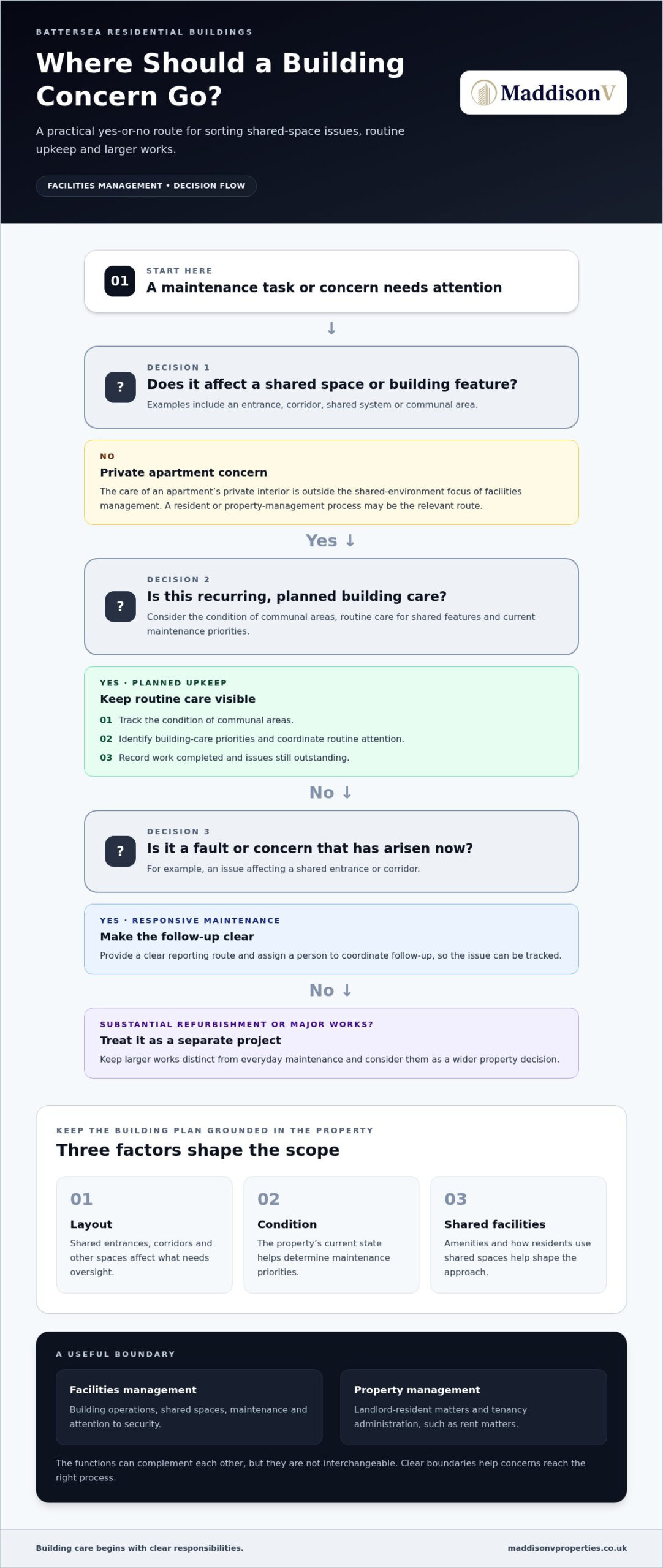
Facilities management focuses on the building’s operational upkeep and shared environment, including maintenance of common areas and attention to security. Property management commonly focuses on the landlord-resident relationship and tenancy administration, such as rent matters. The two functions can complement each other, but they are not interchangeable.
For example, a concern inside one apartment may belong to the resident or property management process, while a fault affecting a shared corridor is an operational matter for the building. Clear boundaries help people direct concerns to the right place and keep responsibilities visible. For owners considering facility management battersea, this distinction is a useful starting point for identifying the building’s needs.
What Should Battersea Facilities Management Cover Day to Day?
Effective facilities management turns operational duties into a coordinated routine. The scope should identify what is planned, how emerging issues are handled, and who oversees security and shared areas. Clear responsibilities help residents understand how to raise a concern and give stakeholders a more useful view of the building’s condition.
Residential facilities management connects shared spaces, building operations and routine upkeep, helping keep a property functional, cared for and welcoming. A useful facility management Battersea plan starts with the building’s actual requirements, rather than a standard checklist.
How planned and responsive maintenance support Battersea buildings
Planned upkeep is the regular attention that helps preserve a building’s condition and supports its shared environment. Depending on the property, this may include tracking the condition of communal areas, identifying maintenance priorities and coordinating routine care for shared building features. Keeping a record of work completed and issues still outstanding helps stakeholders see what has been addressed and what needs follow-up.
Responsive maintenance deals with faults or concerns as they arise. A problem affecting a shared entrance or corridor, for instance, needs a clear reporting route and an assigned person to coordinate follow-up. This differs from a larger planned project, such as substantial refurbishment. Separating routine maintenance from major works helps owners keep everyday tasks visible while treating wider property decisions distinctly.
Why communal areas and security shape the resident experience
Residents use shared spaces as part of their everyday routines, from entering the building to moving through corridors or using communal facilities. The condition of these spaces can affect whether the property feels orderly and cared for. Consistent oversight also helps surface small operational concerns before they become ongoing sources of uncertainty.
Security is another part of the building’s operational picture. Responsibilities should be clear and considered alongside the shared environment. The relevant arrangements depend on the property, so the management plan should reflect its actual needs.
- Planned upkeep: keep routine building-care priorities visible.
- Responsive maintenance: assign responsibility for handling issues as they arise.
- Communal areas: maintain a consistent standard across spaces residents share.
- Security: clarify how operational oversight supports the building’s shared environment.
Battersea includes a range of residential settings, so the balance of tasks will vary with each building’s layout, condition and shared facilities. A considered scope connects recurring care with resident-facing standards and keeps larger works identifiable as separate projects. For a useful comparison of the two management disciplines, see Facilities Management vs. Property Management.
MaddisonV provides facilities management for residential blocks and luxury developments, focusing on operational upkeep, maintenance, security and communal areas. Owners can explore MaddisonV facilities management to bring these day-to-day priorities into clearer view.
How Does Facilities Management Differ from Battersea Block and Residence Management?
In a residential development, “management” can refer to several functions. Facilities management focuses on building operations and the shared environment. Block management centres on administration for the block, while residence management relates to support within an individual home. Their responsibilities can intersect, but each has a distinct purpose.
A structured management arrangement makes responsibilities easier to understand, establishes clear routes for operational issues and keeps owners informed. The key is to define what each function covers and how the people involved coordinate.
| Management function | Primary focus | Residential example |
|---|---|---|
| Facilities management | Operational upkeep of the building and shared environment | Coordinating maintenance of communal spaces and attention to shared building needs |
| Block management | Administration and stakeholder coordination for a residential block | Service-charge administration, budgeting and leasehold matters |
| Residence management | Support focused on a homeowner’s private residence | Arranging or coordinating care relating to an individual apartment |
Facilities management versus block management in SW11
For an SW11 block, facilities management is concerned with the operational condition of the shared property. Block management handles administration that supports the building’s ownership and resident arrangements. This can include service charges, budgets and leasehold matters, alongside coordination with relevant stakeholders.
Some issues require both operational coordination and communication with those responsible for block administration. Neither function automatically replaces the other. A building may need both, with responsibilities arranged to suit its ownership structure and operational requirements.
Whole-building support versus individual residence management
Whole-building facilities management concerns shared areas and building operations, while residence management focuses on an owner’s private home. In a development, a shared-area issue belongs to the building’s operational picture, while a request about an individual apartment sits within the private-residence relationship. Clear boundaries help direct each concern appropriately.
Battersea Power Station is a familiar local reference for large-scale residential development. Across Battersea, buildings differ in their shared spaces, resident expectations and ownership structures. A tailored approach should account for those differences and keep the distinction between whole-building and private-home support clear.
For owners considering facility management battersea, the practical step is to identify which responsibilities relate to the shared building, which belong to block administration and which concern an individual residence. Once those roles are clear, outsourced support can stay organised and responsive to stakeholder needs while keeping the resident experience in view.
How to Organise Facilities Management Priorities for a Battersea Property
A clear facilities management plan starts with the building, not a one-size-fits-all checklist. Owners can improve oversight by understanding the property, assigning operational responsibilities, setting priorities and reviewing how the arrangements are working. The process is straightforward, but the priorities should reflect the building’s condition and the people who use it.
Start with the building, its shared spaces and its users
Begin by recording the property’s shared areas, operational needs and current condition. Consider how residents use the development, what owners need to oversee and where responsibilities intersect. Battersea, within the London Borough of Wandsworth, has residential properties with different layouts, shared facilities and expectations. Understanding a particular building helps set priorities based on its needs, not assumptions about the area.
A useful starting record notes which areas are shared, what routine care they need and any known maintenance concerns. This gives stakeholders a common reference point and helps distinguish recurring upkeep from issues that need further consideration.
Create clear oversight for maintenance and ongoing operations
Once the building’s needs are understood, map who is responsible for each operational task. Make ownership clear for routine upkeep, maintenance coordination, security and communal areas. Where a task involves several stakeholders, define how information should be passed between them so concerns do not get lost between owners, residents and contractors.
Set priorities to suit the property. The building’s condition, the nature of an issue and its effect on shared spaces can all inform what needs attention first. An operational concern affecting everyday use may require a different response from a planned improvement that can be considered over time.
- Understand: note the condition, shared spaces and operational needs of the building.
- Assign: make responsibility for recurring tasks and follow-up clear.
- Prioritise: weigh building condition and stakeholder needs when ordering work.
- Review: keep a record of completed tasks, open concerns and emerging priorities.
Concise updates on completed upkeep, outstanding issues and changing priorities give owners visibility without requiring them to manage every daily detail. Regular reviews also help show whether the arrangements still suit the building as its condition or residents’ needs change.
This building-led approach is central to facility management battersea: tailored priorities, defined responsibilities and consistent oversight support a more dependable operational environment. MaddisonV’s property management approach gives owners a way to explore support shaped around their property and its needs.
MaddisonV Facilities Management for Battersea Residential Properties
Residential buildings rely on connected details: shared areas need attention, maintenance priorities need oversight, and security arrangements form part of the property’s operations. MaddisonV Properties is a London-headquartered firm providing facilities management for residential blocks and luxury developments. Its focus brings these building needs together and helps owners take a considered view of how their property is maintained.
For owners exploring facility management battersea, support should reflect the building itself. A block with particular communal spaces or operational priorities will have different needs from another development nearby. The aim is to shape oversight around the property and the people who use it.
A considered approach to residential building operations
Facilities management is most useful when routine oversight supports the whole shared environment. MaddisonV’s focus includes operational upkeep, building maintenance, security and communal areas. These priorities connect: the condition of shared spaces affects residents’ experience, while attention to maintenance and security supports day-to-day operations.
A tailored approach starts with the property’s layout, condition and operational priorities. Owners and stakeholders can then identify where ongoing attention is needed and how responsibilities fit together. Clear communication keeps priorities visible, while consistent oversight supports a considered standard across shared areas. Residents benefit from a more welcoming, cared-for setting, and owners gain a clearer view of operations without managing every detail themselves.
Every development has its own character. Management arrangements should reflect the building and its users rather than assume that all residential properties have identical needs. In Battersea, buildings can differ in design, shared facilities and expectations. A thoughtful management relationship accounts for these differences while keeping operational responsibilities clear.
Discuss facilities management for a Battersea property
Owners and property stakeholders can begin by outlining the building’s priorities: which shared areas need attention, what maintenance concerns are on the agenda, and how security and operational responsibilities are organised. These details create a practical starting point for discussing support that suits the property and where clearer oversight could help.
MaddisonV provides facilities management for residential blocks and luxury developments, with support shaped around the property. The focus is ongoing oversight of the operational environment, including maintenance, security and communal spaces. To discuss the needs of your Battersea building, Discuss facilities management with MaddisonV.
Set a Clear Direction for Your Building
Decide what a well-run building should look and feel like for the people who live there. Consider which standards matter most, where clearer responsibility would help and what level of oversight would give you confidence without drawing you into every daily task. These priorities provide a practical starting point for a management conversation.
For owners considering facility management battersea, a building-specific plan is more useful than a generic checklist. It turns individual concerns into a coherent view of the property’s needs, keeping residents’ experience and the building’s condition in focus.
Share the priorities that matter to your property and explore a considered management relationship with MaddisonV. Discuss facilities management for your Battersea property and take the next step towards clearer oversight.
Frequently Asked Questions
What does facilities management include for a residential building in Battersea?
The scope is clearest when set out in a building-specific task schedule. Identify which shared areas and assets are covered, what routine checks or upkeep are expected, and how completed work is recorded. For example, distinguish a recurring check of a communal area from a one-off repair request. This detail helps stakeholders understand the arrangement in practical terms.
How is facilities management different from block management?
Facilities management coordinates operational attention to the building, while block management covers administration and stakeholder coordination. Some tasks involve both. A maintenance concern may require someone to coordinate the work, while a separate stakeholder handles approval or related records. Mapping who takes each step helps prevent duplicated effort or a task being left between roles.
Can facilities management improve the experience of residents in Battersea apartments?
Clear routes for reporting concerns and providing useful information can make the process easier for residents. A report that identifies an issue’s location, nature and effect gives the relevant team a clearer starting point. Reviewing recurring feedback can also help stakeholders notice patterns in how residents use shared spaces and inform management decisions.
Who is responsible for maintenance in a Battersea apartment block?
Responsibility depends on the building’s ownership and management arrangements. Owners can review the property’s management documents and maintenance reporting instructions, then identify the appropriate contact for the affected area. When reporting an issue, state its exact location and whether it affects an apartment or shared space. This helps route the concern appropriately.
Is facilities management suitable for a luxury development near Battersea Power Station?
Facilities management can suit a development whose shared facilities and operational needs benefit from coordinated attention. A luxury label alone does not determine the right arrangement. Consider the building’s layout, shared amenities and how residents use those spaces, then set an oversight plan around the property’s needs.
How can property owners keep visibility when facilities management is outsourced?
Agree in advance which decisions need owners’ input and how those items should be presented. A concise update can separate completed work, items awaiting a decision and matters needing further attention. Clarify who can authorise next steps within the arrangement. These boundaries keep owners informed without requiring them to coordinate every routine task.
Does facilities management cover individual homes as well as communal areas?
The agreed scope defines whether support covers private homes as well as communal areas. To route a concern, establish where it occurs, which part of the property it affects and whether it appears limited to one apartment or involves a shared asset. A clear description helps stakeholders identify the appropriate management pathway.

Sign Up Now
Want to read more great articles and blogs subscribe to our newsletter