
Could a corporate let make your London property easier to manage, or add another layer of complexity? For landlords considering corporate lets london...

Could a corporate let make your London property easier to manage, or add another layer of complexity? For landlords considering corporate lets london for landlords, the answer depends on more than the rent on offer. The agreement, the property’s suitability and the day-to-day management all shape whether this arrangement supports your investment goals.
It’s sensible to weigh potential income against concerns about wear, void periods and unclear responsibilities. A corporate let typically names a company as the tenant, but the practical details still matter: who will occupy the home, how it will be used, what the agreement covers and how the property will be cared for.
This guide explains how to assess whether the model fits your property and compare it with other rental arrangements. You’ll consider tenant and property suitability, net returns, maintenance coordination and ongoing oversight. Clear processes and professional property management can make ownership more orderly and less hands-on, while keeping your priorities at the centre.
Key Takeaways
- Assess the company signing the agreement, the people who will occupy the home and how it will be used before choosing a corporate let.
- Match the property’s layout, furnishings, location and maintenance needs to the intended occupier’s practical requirements.
- Compare corporate and conventional letting by weighing responsibilities, flexibility and management demands alongside potential income, not rent alone.
- For corporate lets london for landlords, a clear operating plan helps define responsibilities and support consistent oversight.
- Consider how professional management can coordinate rent collection, tenant relations and routine maintenance around your investment objectives.
Corporate lets in London: what landlords are agreeing to
Before choosing a letting model, establish who will occupy the property, how it will be used, who is responsible for each task and how the arrangement will be managed. A corporate let can suit some London properties, but the label alone won’t tell you whether it fits your investment objectives.
In a corporate let, an organisation, rather than the individual living in the home, is the named contracting party. The organisation may house an employee or another agreed occupier. That distinction matters, as do the agreement’s terms, the property’s actual use and the length and pattern of occupation. Corporate housing can take different forms; What is Corporate Housing? offers a useful introduction to the concept.
How does a corporate let differ from other London rental arrangements?
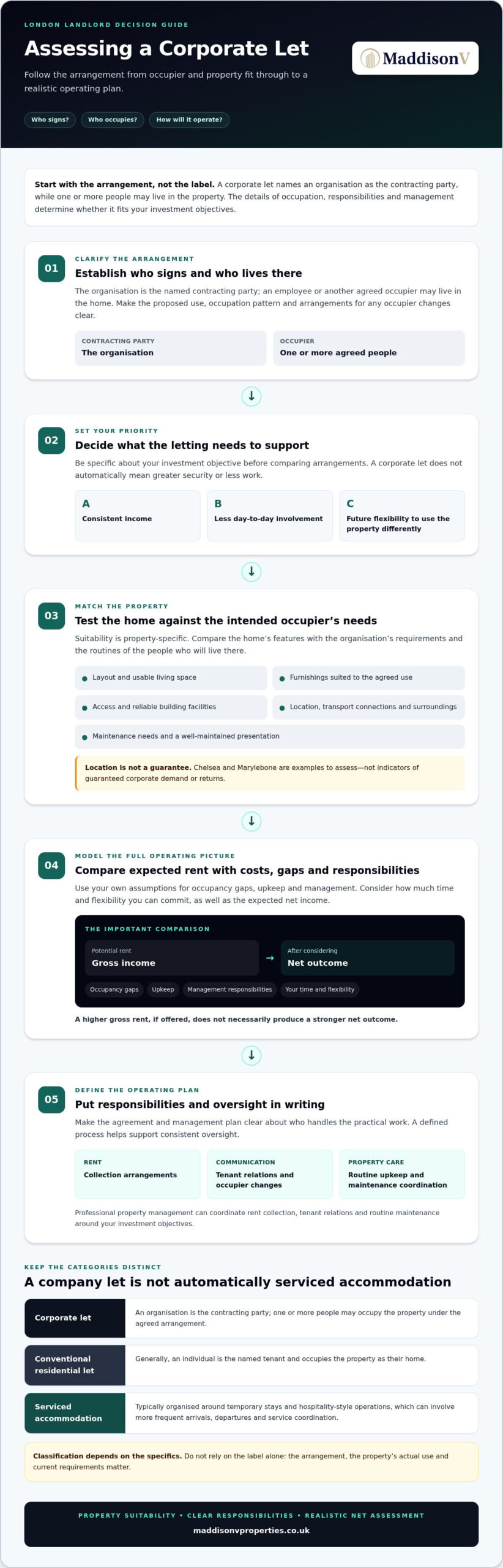
In a conventional residential let, an individual is generally the named tenant and occupies the property as their home. Under a corporate arrangement, an organisation is the contracting party, while one or more people may live in the property. The agreement and management plan should make clear who handles rent, communication, upkeep and any changes to the occupier.
Serviced accommodation differs in purpose and operating style. It is typically organised around temporary stays and hospitality-style operations, which can involve more frequent arrivals, departures and service coordination. A corporate let may also house people temporarily, but it shouldn’t automatically be treated as serviced accommodation or as a conventional individual tenancy. Legal classification depends on the specific arrangement, the property’s actual use and current requirements, so don’t rely on the label alone.
Which London landlords might consider a corporate let?
This model may suit owners who value managed oversight and want a clearly defined occupier profile, such as a home intended for an organisation’s employee. Fit depends on the property as well as the landlord: layout, furnishings, access, location and maintenance needs should align with the proposed use.
For example, a landlord with a property in Chelsea or Marylebone could assess whether its features and location suit the intended occupier. These neighbourhoods are examples, not indicators of guaranteed demand or returns. Focus on whether the agreement supports your priorities, whether responsibilities are workable and whether management demands are proportionate to the expected net income.
For corporate lets london for landlords, a sound decision starts with the arrangement itself, not the assumption that a company tenant automatically means greater security or less work. Assess the occupier, use, responsibilities and operating requirements together before committing.
How to assess whether your London property suits a corporate let
Start with your investment objective, then test whether the property, intended occupier and operating plan work together. This sequence helps you judge the arrangement on its practical merits rather than assuming a corporate tenant means stronger income or less involvement.
- Set your objective: Decide whether your priority is consistent income, less day-to-day involvement or the flexibility to use the property differently later.
- Assess the home: Compare its layout, furnishings, access, location and maintenance needs with the intended occupier’s requirements.
- Plan the operation: Decide how rent collection, tenant relations and routine upkeep will be handled.
What property features matter to corporate occupiers?
Suitability depends on the intended occupier. Transport access may matter to someone commuting to a workplace, while usable living space, reliable building facilities and a well-maintained presentation can support a comfortable stay. A furnished property may be appropriate, but choose furnishings and amenities to suit the likely occupier and agreed use, rather than assuming every company has the same requirements.
Assess location in the same way. A home’s transport connections and surroundings may suit one occupier’s routine but not another’s. Don’t treat any London district as a guarantee of corporate demand. Compare the property’s features with the organisation’s requirements and the needs of the people who will live there.
Does the arrangement fit your investment objectives?
Compare expected rent with the full operating picture. Build a scenario using your own assumptions for occupancy gaps, upkeep and management responsibilities, then consider how much time and flexibility you’re prepared to commit. A higher gross rent, if offered, doesn’t necessarily produce a stronger net outcome once costs and periods without an occupier are included.
Make your assumptions explicit. What happens if the property is vacant between occupiers? Which maintenance tasks need coordination, and who will manage communication? For broader context on London locations and market considerations, explore the London property investment guide. GOV.UK provides a general overview of Landlord and Tenant Rights in the UK; the relevant requirements depend on the specific arrangement.
This makes corporate lets london for landlords a property-specific decision, based on objectives and realistic operating assumptions. For ongoing oversight shaped around your property, consider MaddisonV Properties’ London property management.
Corporate lets versus conventional letting: compare the full landlord experience
A useful comparison goes beyond rent. Consider who signs the agreement, who occupies the home, how much administration each arrangement involves and what a gap between occupiers could mean for your finances and plans.
| Factor | Corporate let | Conventional residential let |
|---|---|---|
| Contracting party | An organisation is named in the agreement; individuals may occupy the property. | An individual is generally named as the tenant and occupies the home. |
| Occupier profile | May be an employee or another agreed occupier, as set out in the arrangement. | The named tenant, with any permitted occupiers determined by the agreement. |
| Management needs | May involve communication with both the organisation and the occupier, alongside rent and property oversight. | Usually centres on communication and administration with the tenant. |
| Flexibility | Depends on the agreement, intended use and applicable requirements. | Depends on the agreement and applicable requirements. |
| Landlord involvement | Can include coordinating responsibilities across the contracting party and occupier. | Typically involves managing the tenant relationship and property responsibilities. |
What should landlords compare beyond headline rent?
Estimate the likely net outcome by considering expected occupancy, potential void periods, routine upkeep, management effort and any preparation the property needs. Furnishing or adjusting a home for a particular occupier can bring additional costs and maintenance considerations. A higher proposed rent alone doesn’t show which arrangement will leave you better placed after these demands are considered.
Use scenarios based on your property and assumptions, rather than relying on generic yield promises. For example, compare how each model would work if the home needed repairs between occupiers or remained empty for a period. The RICS Residential Property Standards provide wider context on professional standards in residential property.
How do control, flexibility and day-to-day work differ?
Either model requires someone to oversee rent administration, occupier communication and maintenance coordination. A corporate let can involve communication with both the organisation and the person living in the property, while a conventional let generally focuses on the tenant relationship. The agreement and applicable requirements shape the landlord’s control and flexibility, so assess those details before deciding.
For a closer look at how structured oversight can support landlords, read the landlord property-management guide.
The best model depends on property fit, net outcomes and management requirements. For corporate lets london for landlords, comparing those factors together gives a more considered view than headline rent alone.
Prepare your London property and management plan before letting
A well-prepared home and a clearly assigned operating plan make the arrangement easier to oversee. Before a corporate let begins, review the property’s condition, intended use, documentation and each party’s responsibilities. Clear records also help you track upkeep and administration over time.
What should landlords organise before a corporate let begins?
Start with a practical review of the home. Check its presentation, identify maintenance needs and consider whether access arrangements and furnishings suit the people expected to occupy it. A property intended for an employee relocating to London may need different furnishings or amenities from one used by an organisation for another purpose. Base decisions on the agreed use, not a generic checklist.
Before occupation, record the property’s condition and document agreed responsibilities, including how concerns will be reported and addressed. Keep the agreement and property records organised. Requirements can depend on the arrangement and may change, so verify current legal, safety and tax responsibilities through authoritative sources before proceeding.
Which management tasks need clear ownership?
Map the day-to-day tasks and assign responsibility for each one. A simple operating plan can cover:
- Rent collection: who monitors payments and handles routine administration.
- Occupier communication: how requests and updates are shared between the organisation, occupier and landlord.
- Routine maintenance: who receives reports, coordinates work and keeps a record of issues.
- Escalation: how urgent or unresolved property concerns are passed to the responsible person.
In a residential development, building-level facilities management may also affect the experience of living in the property. Clarify how shared areas and building facilities are managed alongside maintenance inside the home. Defined responsibilities can bring order to administration, although they don’t remove the need for sound oversight.
For corporate lets london for landlords, preparation means aligning the home, documentation and management plan with the intended use. A tailored approach to rent collection, tenant relations and routine maintenance coordination can help keep ownership organised.
To put a considered management plan in place for your property, explore MaddisonV property management.
Manage a London corporate let with confidence and clear oversight
A corporate let works best when the property, the occupier’s practical needs and the management plan align. Choosing the arrangement is only the starting point. Ongoing oversight helps keep the home presentable, responsibilities visible and rental administration organised, without assuming that any letting model guarantees occupancy or investment performance.
What does ongoing oversight involve for a landlord?
Effective management brings key tasks into a clear routine: rent collection, communication with the occupier and coordination of routine maintenance. Recording reported issues and work carried out helps you follow the property’s condition and make informed decisions about upkeep. Consistent attention supports an organised ownership experience, while recognising that occupancy and income can vary.
How can MaddisonV support a considered landlord plan?
MaddisonV Properties provides property management tailored to the landlord’s property, objectives and day-to-day requirements. This can include coordinating rent collection, tenant relations and routine maintenance, bringing practical tasks together under a structured approach. For landlords of residential developments, facilities management also supports the operational upkeep of buildings.
The right level of oversight depends on your priorities. You may want support with specific management tasks or a more comprehensive approach to ongoing property administration. Defining those requirements helps shape a plan around your investment, rather than relying on a one-size-fits-all model. For corporate lets london for landlords, disciplined management can provide clarity and continuity without promising a particular rental outcome.
If you’re weighing up how much involvement your property needs, discuss your London property-management requirements with MaddisonV. A considered conversation can connect your objectives with a practical approach to oversight.
Make your next letting decision with confidence
A corporate let is most suitable when the agreement, intended occupier and property align with your investment priorities. Before committing, weigh expected income against void periods, upkeep and management demands. A realistic view of net outcomes, supported by clear responsibilities, is more useful than headline rent alone.
For corporate lets london for landlords, a considered operating plan can make ongoing ownership more orderly. MaddisonV Properties provides property management covering rent collection, tenant relations and routine maintenance coordination, as well as facilities management for the operation of residential blocks and developments.
If you’re considering how much oversight your property needs, discuss your London property-management requirements. MaddisonV can help you shape a practical approach to managing your property around your objectives.
Frequently Asked Questions
What is a corporate let in London?
A corporate let is an arrangement where a company or other organisation, rather than the person living in the property, is the named contracting party. The organisation may provide the home for an employee or another agreed occupier. For corporate lets london for landlords, consider the agreement, actual use of the home and responsibilities together. The corporate label alone doesn’t determine the applicable legal classification or requirements.
Are corporate lets more profitable than conventional lets?
Not necessarily. Compare expected rent with the full costs and work involved, including void periods, routine maintenance, furnishing and management. A higher headline rent may not produce a stronger net return if preparation or ongoing oversight is more demanding. Build a comparison using assumptions that reflect your property, likely occupancy and objectives. The right arrangement is the one whose overall income and responsibilities make sense for your investment, not simply the one with the larger quoted rent.
Can a landlord let a London property to a company?
Yes, a landlord can enter into an arrangement with a company as the contracting party, provided the property’s intended use and agreement are appropriate. Set out who may occupy the home, how it will be used and how rent, communication and maintenance responsibilities will be handled. The agreement and circumstances matter, so don’t assume that rules applying to one type of residential let apply identically to every corporate arrangement. Check current requirements for your specific situation.
How long does a corporate let usually last?
There isn’t one standard duration for every corporate let. The length depends on the organisation’s requirements, the intended occupier’s circumstances and the terms agreed by the parties. Before proceeding, consider how the proposed period fits your plans for the property, what happens if the occupier’s needs change, and how continuation or ending the arrangement is handled. Let the agreement and current requirements guide the decision rather than an assumed market norm.
Who is responsible for repairs in a corporate let?
Responsibilities should be set out clearly in the agreement, including how the occupier reports an issue and who coordinates work. The organisation, occupier and landlord may each have different roles, so clarity matters. Plan how routine maintenance will be monitored and concerns communicated. A property manager can coordinate rent collection, tenant relations and routine maintenance, helping keep records and day-to-day oversight organised without changing the responsibilities agreed between the parties.
Are corporate lets the same as serviced accommodation?
No. A corporate let describes an arrangement where an organisation is the contracting party and someone occupies the home under agreed terms. Serviced accommodation is generally organised around temporary stays and hospitality-style services, often involving more frequent arrivals and departures. The categories aren’t interchangeable: the agreement, actual property use and applicable requirements matter. Consider whether the proposed arrangement is residential letting or a more service-led accommodation model before deciding how to manage the property.

Sign Up Now
Want to read more great articles and blogs subscribe to our newsletter