What if building upkeep felt less like a stream of small decisions and more like a coordinated part of ownership? For property owners considering...

What if building upkeep felt less like a stream of small decisions and more like a coordinated part of ownership? For property owners considering facility management Chiswick, the challenge is familiar: maintenance needs attention, communal areas shape residents’ day-to-day experience, and it isn’t always clear where facilities management ends and property management begins.
Professional facilities management brings structure to those responsibilities. MaddisonV Properties provides facilities management for residential blocks and luxury developments through fixed-term contracts. The service coordinates operational upkeep, building maintenance, security and communal-area management, with arrangements tailored to the development.
This guide explains what facilities management can cover in a Chiswick residential property, how it supports shared spaces and ongoing maintenance, and how its role differs from property management. It also offers a practical framework for setting priorities and clarifying which responsibilities fall within a building’s management scope.
Key Takeaways
- Learn what facility management Chiswick can cover in residential blocks and how it helps owners organise building operations.
- Understand how planned attention to shared spaces can support residents’ day-to-day experience.
- See the difference between facilities management and property management, and how the responsibilities can complement one another.
- Use a practical framework to set building priorities around the development, communal areas and residents’ needs.
- Discover how MaddisonV Properties coordinates operational upkeep, maintenance, security and communal-area management through facilities management contracts.
What Does Facility Management in Chiswick Cover?
Facility management coordinates a building’s operational upkeep, maintenance, security and shared spaces so a residential property can function effectively for residents and owners. In Chiswick, this typically means focusing on the operation of a residential block or development, rather than repairs inside an individual home.
The practical scope depends on the building. Start by listing its shared areas and facilities, then identify the recurring upkeep and oversight each requires. This makes it easier to distinguish building-wide responsibilities from issues specific to an individual home or tenancy. For a wider overview of the field, see What is facility management.
To see a general example of facilities management in practice, watch this video:
Which building responsibilities can facilities management cover?
For a residential block, facilities management can coordinate:
- Operational upkeep: Organising the practical routines that help the building function smoothly.
- Building maintenance: Coordinating upkeep of the property and its shared facilities.
- Security: Including security within the building’s operational arrangements.
- Communal-area management: Overseeing shared spaces residents use in everyday life.
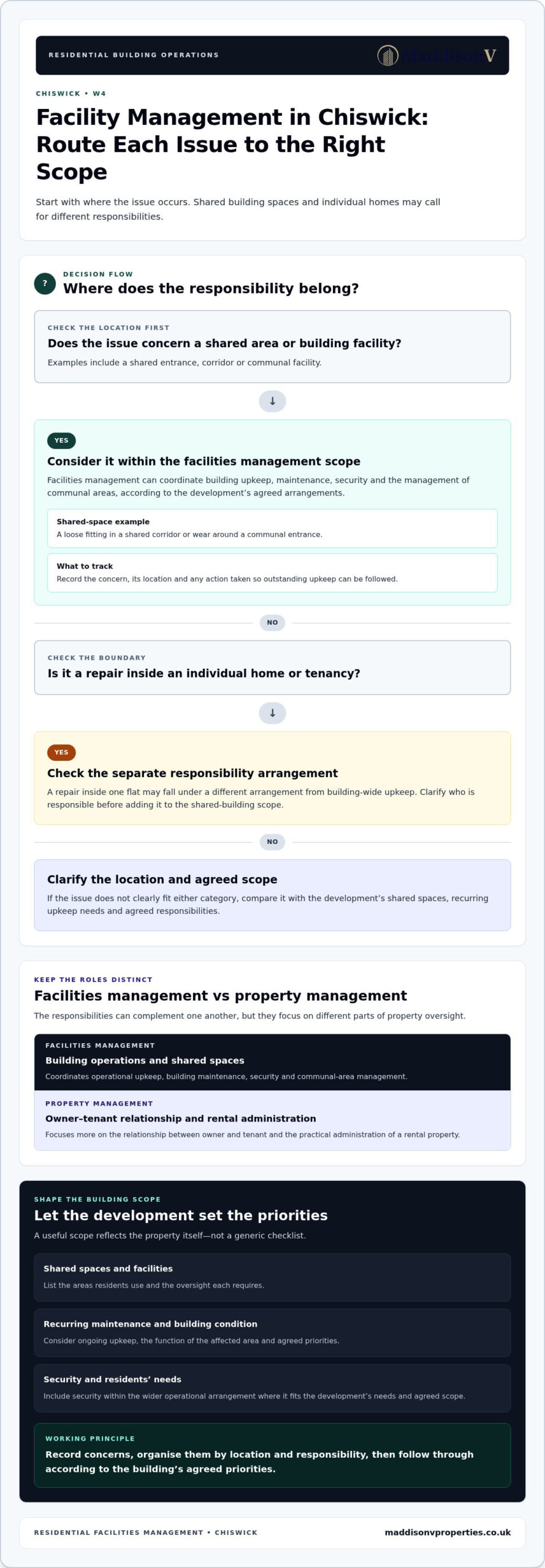
These responsibilities connect, but they are not interchangeable. A maintenance concern in a shared entrance, for example, relates to the wider building; a repair inside one flat may fall under a different arrangement. Defining these boundaries helps owners keep track of what needs attention and who is responsible for each type of issue.
Why does local context matter for Chiswick properties?
Residential properties in Chiswick and W4 vary in layout, shared facilities and patterns of use. A development with several communal spaces has different operational priorities from a block with only a shared entrance. Residents’ needs and how they use those areas also help determine what requires regular attention.
Effective facility management Chiswick starts with the property itself. Owners can consider the building’s shared spaces, recurring maintenance needs and security responsibilities, then use those priorities to shape the management scope. This avoids relying on a generic checklist that may not fit the development.
How Facilities Management Supports Chiswick Residential Buildings
Residents experience a building through everyday details: whether shared spaces feel cared for, whether there is a clear way to raise maintenance concerns, and whether the property feels orderly. Facilities management brings these details into a coordinated view through attention to upkeep, security and communal areas. That can also help owners see building responsibilities more clearly.
Coordinated building upkeep gives owners a clearer view of ongoing responsibilities and supports a more orderly experience for residents. In a Chiswick residential block, this means considering how shared spaces are used and how maintenance needs are recorded, prioritised and followed through as part of the development’s overall operation.
How maintenance coordination helps keep shared spaces functional
Maintenance is easier to oversee when observations are recorded and considered together, rather than handled as disconnected concerns. For example, a resident might report a loose fitting in a shared corridor or wear around a communal entrance. Keeping a record of the concern, its location and any action taken helps owners track outstanding work and compare it with other upkeep priorities.
Not every issue has the same urgency or requires the same response. The building’s condition, the function of the affected area and the agreed priorities all inform how needs are organised. A coordinated view can make it easier for owners to follow open items and understand the status of shared-space upkeep.
How security and communal areas fit into building oversight
Security is part of facilities management alongside the care of communal areas. Its place in the arrangement depends on the development’s needs and agreed scope. Including security in the wider operational picture helps owners consider it alongside maintenance and shared-space management, rather than treating it as an unrelated responsibility.
Communal areas shape the impression a development makes. Their upkeep affects how residents experience entrances, corridors and other shared spaces. Consistent attention to these areas can help maintain a sense of order and care, not only when a repair is needed but as part of everyday building oversight.
For a broader overview of the subject, see this facilities management reference. A tailored approach to facility management Chiswick can help owners coordinate responsibilities around the development and its residents. Learn more about residential facilities management from MaddisonV Properties.
Facilities Management vs Property Management in Chiswick
The terms are sometimes used interchangeably, but they describe different areas of oversight. Facilities management centres on how a building and its shared spaces operate. Property management focuses more on the owner-tenant relationship and the practical administration of a rental property. The industry perspective on facility management also centres on the effective functioning of the built environment.
| Responsibility | Facilities management | Property management |
|---|---|---|
| Primary focus | Building operations and shared spaces | Tenancy and rental-property management |
| Typical responsibilities | Operational upkeep, building maintenance, security and communal-area management | Rent collection, tenant relations and routine maintenance coordination |
| Main perspective | The development as a functioning, shared environment | The individual property, its tenancy and owner responsibilities |
What is the difference between building operations and tenancy management?
Facilities management takes a building-wide view: how shared spaces are maintained and how upkeep and security fit into day-to-day operations. Property management addresses rental and tenancy matters, including rent collection and communication with tenants. Maintenance can feature in both, but from different angles. Facilities management concerns the building and its shared areas, while property management coordinates routine maintenance in relation to a tenancy.
To determine the right scope, separate building-wide tasks from tenancy responsibilities. A maintenance concern in a communal corridor, for example, differs from a repair within an individual rental home. Clear responsibilities help owners track each issue through the appropriate management arrangement.
When might a property need both types of management?
A residential investment within a block may involve both sets of responsibilities. The owner may need support with tenancy matters for their individual property, while the development also requires attention to shared areas, building upkeep and security. These are distinct needs, but they can complement one another when responsibilities are clearly defined.
Not every property requires both services. For a Chiswick block with rental homes, separating building operations from tenancy management can make oversight more straightforward and prevent unrelated tasks from being treated as the same issue. For a closer look at the tenancy-focused side, read the guide to property management. Facility management Chiswick can sit alongside property management when an owner needs support with both the shared development and individual rental homes.
How Facilities Management Can Be Organised for a Chiswick Property
A considered facilities-management arrangement begins with the property, not a generic checklist. For a Chiswick residential block or development, shared spaces, operational needs and residents’ expectations help shape priorities. These four steps offer a practical framework for property owners thinking through the scope:
- Understand the building: List its shared areas, facilities and day-to-day operational requirements. A residential block and a luxury development may have different layouts and resident needs.
- Set priorities: Identify the upkeep, security and communal-area responsibilities that matter most, taking account of the building’s condition and how residents use its shared spaces.
- Define responsibilities: Clarify which tasks relate to the wider development and which concern an individual property or tenancy. This makes it easier to route issues to the right management function.
- Review the scope: Revisit the arrangement when the property or residents’ needs change, so its priorities remain relevant.
Start with the building’s operational needs
Understanding a property means looking at how it functions as a shared environment. Consider the communal spaces, the responsibilities involved in their upkeep and the needs of the people who use them. A smaller block may have different operational considerations from a luxury development with a different mix of shared facilities. The aim is to identify what the building needs and which responsibilities should be in scope.
Coordinate and review the agreed management scope
Once priorities are clear, maintenance, security and communal-area responsibilities can be considered within one overall management approach. Clear boundaries help owners understand what falls within the agreed scope and how each responsibility relates to the development’s day-to-day operation. Reviewing priorities as circumstances change helps keep the arrangement aligned with the property.
This structured approach can make facility management Chiswick easier for owners to oversee while keeping attention on the development and its residents. For wider context on the area’s property environment, explore the London property market guide. MaddisonV Properties provides facilities management for residential developments, coordinating operational upkeep, maintenance, security and communal areas.
Facilities Management in Chiswick with MaddisonV Properties
For owners of residential blocks and luxury developments, building oversight involves more than responding to individual maintenance concerns. It calls for an arrangement that brings shared-space upkeep, security and day-to-day operations into a clear scope. MaddisonV Properties provides facilities management through fixed-term contracts, tailored to the development and its needs.
A considered approach to residential building oversight
The facilities management scope covers operational upkeep, building maintenance, security and communal-area management. Coordinating these responsibilities can help owners take a more structured view of how the building is cared for and keep the needs of shared spaces in focus.
Each development has its own operational character. Its communal areas, building requirements and residents’ needs inform how responsibilities are arranged. A tailored approach focuses on the property itself rather than applying an identical scope to every block. For owners, this makes it easier to see which practical building responsibilities are included in the management arrangement.
Facilities management is distinct from tenancy-focused property management, though the two can complement one another where a block contains rental homes. Facilities management centres on building operations and shared areas; property management covers matters such as tenant relations and rent collection. Keeping the focus of each responsibility clear helps owners understand how different aspects of a property are managed.
Next steps for property owners and residential stakeholders
A useful starting point is to outline the type of building, the shared spaces residents use and the main operational priorities. This gives the management arrangement a practical foundation and helps its scope reflect the development. Owners can also reconsider priorities as the building or residents’ needs change.
For owners considering facility management Chiswick, MaddisonV Properties coordinates key building responsibilities through fixed-term contracts. The scope can bring operational upkeep, maintenance, security and communal areas into a considered management arrangement.
Explore facilities management with MaddisonV Properties to see how building responsibilities can be organised around your residential development.
Bring Greater Clarity to Building Oversight
Effective facility management Chiswick brings operational upkeep, maintenance, security and communal-area management into an approach shaped around the development. Understanding how these responsibilities differ from tenancy-focused property management also helps owners identify where the services may complement one another.
MaddisonV Properties provides facilities management for residential blocks and luxury developments through fixed-term contracts, with scope tailored to the property’s needs. Coordinated oversight keeps building responsibilities and shared spaces in focus.
Explore facilities management with MaddisonV Properties to discuss a tailored management arrangement for your residential development.
Frequently Asked Questions
What does facilities management include for a residential property in Chiswick?
Facilities management can include operational upkeep, building maintenance, security and communal-area management. The arrangement depends on the development’s layout, shared spaces and operational priorities. For a residential block, the focus is the building and its shared environment, rather than repairs inside an individual home. A clearly defined scope helps owners understand which building responsibilities are being coordinated.
Is facilities management different from property management?
Yes. Facilities management focuses on building operations, including upkeep, security and shared areas. Property management is more concerned with the rental relationship and tenancy administration, such as rent collection and tenant relations. Routine maintenance coordination may relate to either, depending on whether the issue concerns an individual rental home or the wider development. The services have distinct focuses but can complement one another when both needs exist.
How can facilities management help a residential block?
It gives owners a structured way to coordinate building maintenance, security and communal-area responsibilities. A considered approach keeps the development’s operational needs in view rather than treating each concern as unrelated. Residents experience the shared environment every day, while owners can follow building responsibilities more clearly. The scope should reflect the property and its residents, rather than assuming every block has identical needs.
Who needs facilities management for a property in Chiswick?
Facilities management can suit owners and stakeholders responsible for the operation of a residential block or luxury development, particularly where shared spaces and building upkeep need coordinated attention. A standalone home with no communal areas has different operational considerations from a residential development with shared facilities. The key question is whether building-wide responsibilities would benefit from a defined management arrangement.
Can facilities management and property management work together?
Yes. A residential investment within a block may involve tenancy needs for an individual home as well as operational responsibilities for the wider development. Property management can focus on rent collection and tenant relations, while facilities management addresses building upkeep, security and communal areas. Their scopes can work alongside each other when responsibilities are clear and reflect the property’s management requirements.
How is facilities management tailored to a Chiswick development?
Facility management Chiswick should reflect the development’s building type, communal spaces and residents’ needs. A residential block and a luxury development may have different operational priorities, so the arrangement should fit the property rather than rely on a one-size-fits-all scope. MaddisonV Properties provides facilities management through fixed-term contracts for residential blocks and luxury developments, covering operational upkeep, maintenance, security and shared areas.

Sign Up Now
Want to read more great articles and blogs subscribe to our newsletter