
A UK property purchase doesn’t automatically mean every overseas buyer needs the same banking route. If you’re exploring a uk buy-to-let mortgage for...

A UK property purchase doesn’t automatically mean every overseas buyer needs the same banking route. If you’re exploring a uk buy-to-let mortgage for non-residents, the right account to investigate may depend on how you plan to buy, receive rent and manage property payments, as well as each provider’s eligibility rules.
It’s understandable to be unsure whether you can apply from abroad, whether a personal or company account is more suitable, and what evidence you’ll need. Standard accounts may ask for a UK address, while some international or digital providers consider applications using overseas address details. Requirements vary, so check directly with each provider before relying on a particular route.
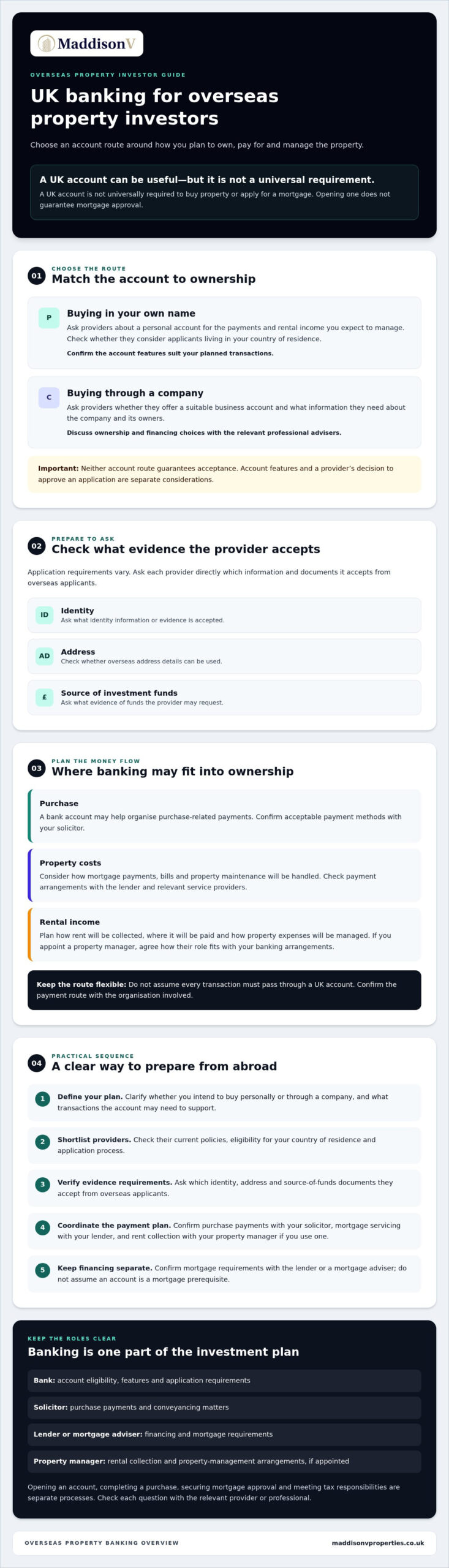
This guide explains the main account options, the identity, address and source-of-funds information providers may request, and the questions to ask before applying. It also covers how to coordinate banking with your purchase, financing and rental-income plans. A UK account isn’t universally required to buy property or apply for a mortgage, and opening one doesn’t guarantee mortgage approval. Treating banking as one part of your investment plan can help you prepare with greater clarity.
Key Takeaways
- Consider a UK account as a practical tool for managing property payments and rental income, not a universal requirement for buying or financing a property.
- Compare personal and company account routes against your ownership structure and intended transactions before approaching providers.
- Ask each provider which identity, address and investment-funds documents it accepts from overseas applicants.
- If you’re exploring a uk buy-to-let mortgage for non-residents, coordinate banking questions with your financing and rental plans without assuming an account is a mortgage prerequisite.
- Shortlist providers and verify their current application policies. Keep the separate roles of banks, mortgage advisers, solicitors and property managers clear.
Why a UK bank account can matter in a property investment plan
A UK bank account can be a useful operational tool for an overseas property investor, helping organise payments linked to a purchase and ownership. It isn’t automatically required to buy UK property or apply for a mortgage. The right arrangement depends on the transaction and on what the organisations involved will accept.
Think of banking as one part of the wider investment plan. Opening an account, completing a purchase, securing mortgage approval and meeting tax responsibilities are separate processes, each with its own provider or professional to consult.
For additional context on the customer-verification concept, see this overview of Know Your Customer (KYC) checks.
For financing context, watch this video on obtaining a UK mortgage as a non-resident:
Which parts of a UK property investment might involve banking?
Depending on the arrangements, an account may help you manage payments connected with the purchase, mortgage, bills or property maintenance, and receive rental income. Confirm acceptable payment methods with your solicitor, lender and any relevant service provider rather than assuming every transaction must pass through a UK account.
Rental income also needs a clear plan. Ask how rent will be collected, where it will be paid and how property expenses will be handled. If you appoint a property manager, agree how their role fits with your banking arrangements. Rent collection and account provision are distinct matters.
Does an overseas buyer always need a UK account?
No single answer applies to every purchase. Requirements depend on the transaction and the organisations involved. Ask your solicitor about purchase payments, your lender about mortgage servicing, and each bank about its account criteria and application process. A uk buy-to-let mortgage for non-residents raises financing questions to confirm with the lender or a mortgage adviser, separately from account eligibility.
In brief: Treat a UK account as a possible way to organise investment finances, not a universal condition of ownership. Confirm the payment route, account requirements and rental-income process with the relevant providers before relying on a particular setup. For broader financing considerations, see The Sophisticated Investor’s Buy-to-Let Mortgage Guide (2026 Edition).
Personal or company account: compare the route before applying
Choose an account route based on the intended ownership structure and how you expect to use the account. If you’ll buy in your own name, ask about a personal account. If a company will own the investment, ask providers whether they offer a suitable business account and what information they need about the company and its owners.
Neither route guarantees acceptance. Account features, including available payment services, are separate from a provider’s decision to approve an application. Check eligibility for your country of residence and circumstances directly with each provider, then review ownership and financing choices with the relevant professional advisers.
When should an investor investigate a personal account?
If you’ll own the investment as an individual, a personal account may be the natural option to ask about for receiving rent or organising property-related payments. Don’t assume every provider accepts applicants living overseas. Confirm whether it considers applications from your country of residence, what information it requires, and whether its account features suit the transactions you plan to make.
When might a company account be relevant?
If a company will own the property, ask providers about business-account options rather than assuming a personal account will serve the same purpose. Discuss the company’s details, ownership structure and investment plans with your professional advisers. For a UK-registered company, its Companies House details may help explain its verified status, but ask the provider what information it needs and how it assesses applications.
Use questions like these to compare providers. Their answers, rather than a general rule, should guide your next step.
| Ask about | Question for the provider |
|---|---|
| Applicant and structure | Do you consider applications from someone resident in my country, and do you offer the account type I need? |
| Documents | What information do you require about me, the company and its ownership? |
| Planned use | Can the account support the payments and rental-income arrangements I expect to use? |
| Application decision | What steps determine whether an application is accepted, and how will you confirm the outcome? |
This comparison can help keep your banking decision aligned with the wider investment plan. A uk buy-to-let mortgage for non-residents is a separate financing matter, so discuss mortgage eligibility with a lender or mortgage adviser rather than treating account approval as mortgage approval. MaddisonV Properties offers property sourcing and mortgage consultations. Explore its property investment services as part of planning your purchase and ownership approach.
What to prepare before applying for a UK account from abroad
Preparing to apply is less about assembling a universal checklist and more about confirming what a particular provider will accept. Before sending documents, ask about its current requirements for overseas applicants, how documents should be submitted, and whether any need to be translated, certified or authenticated. Keep account-opening information distinct from documents requested by a mortgage lender or another professional.
Requirements vary by provider and applicant circumstances, so confirm the exact document list and submission process before applying.
Which documents might a provider ask you to prepare?
Use these categories to frame your questions, not as a guaranteed checklist. Ask the provider:
- Identity: Which forms of identification do you accept from someone living in my country?
- Residential address: What evidence of my current address is suitable, and how recent must it be?
- Investment funds: Will you ask about the source of funds, and what evidence would support my explanation?
- Submission and authentication: Can documents be uploaded or sent remotely, and do you require originals, certified copies or translations?
These questions can help you avoid preparing paperwork in a format the provider won’t accept. If you’re planning a uk buy-to-let mortgage for non-residents, ask the lender or mortgage adviser separately about finance-related evidence. An account application and a mortgage application are distinct processes.
How should company applicants prepare?
A company application may involve questions beyond those asked of an individual. Before applying, ask the provider what it needs to understand the company’s registration details, ownership structure and authorised signatories. If the company is registered in the UK, check whether the provider will ask for information to verify its Companies House details.
Share the provider’s requirements with your professional advisers so they can help check that the company information is consistent and ready to submit. Don’t assume company registration alone determines account eligibility, or that one provider’s document list applies elsewhere. The provider decides what information it requires and whether to accept the application.
A clear preparation plan can make the next conversation more focused: identify the applicant, confirm the accepted evidence, and clarify how the documents must be delivered. Banking providers assess account applications; mortgage advisers address financing, while property professionals can help coordinate other parts of the investment process.
How to apply: a practical sequence for overseas property investors
Start with your investment workflow, not a provider’s headline features. Use these steps to identify an account route, check whether it fits your circumstances and understand what happens after you apply.
- Define the account’s role. Write down the transactions you expect it to support, such as receiving rental income or paying property-related expenses. Note whether you’re applying as an individual or for a company.
- Shortlist providers. Check each provider’s current non-resident application policy and whether it accepts applicants who live in your country. Compare the application route, account access and support for the currencies relevant to your plan.
- Confirm details directly. Ask about eligibility, account use, supported currencies and any limitations that could affect your intended transactions. Record the answers and when you received them, then verify important details with the provider before proceeding.
- Prepare the requested information. Ask for the provider-specific document list and submission instructions. Make sure you understand how it wants overseas documents supplied before beginning the application.
- Submit and clarify next steps. Follow the provider’s process, then ask how it will communicate about progress, when you can expect an update, and what steps follow if the account is approved. Processes and timings can differ, so don’t rely on an assumed schedule.
How can you assess providers before applying?
Compare each option against the practical needs you identified, not just the account type. Ask whether your country of residence falls within its current application policy, how you’ll access the account, and whether the currencies you need are supported. Keep a simple record of responses, including any conditions or unanswered questions. Confirm critical details with the provider before submitting.
What should you do if the first route is unsuitable?
Ask the provider to explain what makes the route unsuitable and whether you’ve misunderstood a requirement. If it can’t meet your needs, review other providers’ current policies rather than assuming another application will be accepted. Questions about company ownership or financing may also warrant advice from appropriately qualified professionals.
Banking is one part of a wider investment plan. An account provider decides whether to accept an application; mortgage consultations address financing, while property sourcing can help inform the acquisition plan. If you’re exploring a uk buy-to-let mortgage for non-residents, coordinate those decisions without treating account approval as mortgage approval. MaddisonV Properties offers property sourcing and mortgage consultations through its property investment services.
Coordinate banking with your UK purchase, mortgage, and rental plan
Banking works best as part of a joined-up ownership plan. Before committing to an account route, map how you expect to fund the purchase, handle mortgage payments, receive rent and manage property expenses. Then confirm the arrangements with the organisations responsible for each part. A UK account may be convenient, but it doesn’t replace advice or decisions from your lender, solicitor or property manager.
How does banking fit alongside a buy-to-let mortgage?
Account arrangements and lending decisions are separate. Ask the bank about its account application and features; ask the lender or mortgage adviser about mortgage eligibility, application requirements and how repayments are handled. Opening an account doesn’t secure or improve mortgage approval. For broader financing context, read The Sophisticated Investor’s Buy-to-Let Mortgage Guide (2026 Edition).
Keep the roles clear. The bank assesses the account application, a mortgage adviser can discuss financing, and your solicitor supports the legal work involved in a purchase. Their requirements and processes may interact, so raise practical questions early and confirm each answer with the professional responsible.
How can professional support simplify the investment process?
Once the property is acquired, banking decisions become part of the ongoing operating plan. Consider how rent will be collected, where it will be paid and how property expenses will be coordinated. If you appoint a property manager, agree how rent collection, tenant relations and your own account arrangements will work together. The Sophisticated Investor’s Guide to Property Management in 2026 offers further context on rental operations.
MaddisonV Properties provides property sourcing, mortgage consultations and property management. These services can support different parts of an investor’s plan: sourcing can inform the acquisition, mortgage consultations can address financing, and property management can support ongoing ownership. They don’t include opening a bank account or deciding whether a provider will accept an application.
If you’re considering a uk buy-to-let mortgage for non-residents, list the questions you need answered about the property, finance, account arrangements and rental management. Then take each to the relevant provider or adviser. If you’d like to discuss how property sourcing, mortgage consultations or property management could fit your investment plan, you can speak with MaddisonV without assuming any banking outcome or investment return.
Make your next investment steps clear and coordinated
A UK bank account can help organise property-related payments and rental income, but it isn’t a universal requirement for buying property or applying for a mortgage. The most suitable route depends on whether you’re investing personally or through a company, the provider’s current policies and how you plan to manage the property.
Before applying, confirm the provider’s eligibility criteria, accepted documents and application process directly. Keep banking decisions separate from purchase arrangements, tax responsibilities and mortgage lending. If you’re considering a uk buy-to-let mortgage for non-residents, discuss financing with an appropriate mortgage adviser or lender, and coordinate account questions with the bank.
MaddisonV Properties is a London-based property investment advisory and management firm offering property sourcing, mortgage consultations and property management. These services can support different stages of an investment plan, without replacing a bank’s account decision. Discuss your UK property investment plans with MaddisonV and take your next steps with greater clarity.
Frequently Asked Questions
Can a non-resident open a UK bank account for property investment?
Some UK providers may consider applications from overseas property investors, but eligibility and application routes vary. Ask each provider directly whether it accepts applicants who live in your country of residence, what account options it offers and what information it requires. Approval isn’t guaranteed. Separately, confirm acceptable payment arrangements with your solicitor, lender and other relevant professionals involved in the purchase. Account eligibility doesn’t determine how every transaction must be handled.
Do I need a UK bank account to buy a buy-to-let property?
There’s no single answer that applies to every purchase or financing arrangement. A UK account may help you organise some property-related payments or rental income, but don’t assume it’s always required to buy a property or obtain a mortgage. Ask your solicitor, lender and other relevant providers which payment methods they accept for your circumstances. Confirm those arrangements before making plans based on a particular account being available.
Should I open a personal or company bank account for UK property investment?
The appropriate route depends on who will own the property and which transactions the account needs to support. If you’re investing personally, ask providers about suitable personal-account options; if a company will own the property, ask about business accounts. Discuss the ownership structure with qualified advisers, then check which account types providers consider for applicants in your circumstances. Neither one structure nor a provider’s decision is right for every investor.
What documents might a UK bank request from an overseas property investor?
Depending on the provider and application, it may ask for identity, residential-address, company or source-of-funds information. These are examples, not a complete or official checklist. Request the provider’s current requirements before applying, and ask how overseas documents must be submitted, including whether a particular format is needed. If a company is involved, confirm directly what information it needs about the company and its ownership structure.
Can I receive UK rental income into an account outside the UK?
That depends on the arrangements accepted by the relevant parties and the terms of their services. Ask your property manager, bank and any other providers involved which payment methods they support, including whether they can pay rent into an overseas account. Don’t assume every provider accepts this arrangement or that a UK account is mandatory. For questions about currency handling or reporting, seek advice from an appropriately qualified professional.
Does opening a UK bank account help me get a buy-to-let mortgage as a non-resident?
Opening an account and applying for a mortgage are separate decisions; an account doesn’t secure or improve mortgage approval. Lender criteria and documentation can vary, so discuss your circumstances with a suitable mortgage adviser and the lender you’re considering. If you’re exploring a uk buy-to-let mortgage for non-residents, review The Sophisticated Investor’s Buy-to-Let Mortgage Guide (2026 Edition) for broader financing context, then verify current requirements directly with the relevant professionals.

Sign Up Now
Want to read more great articles and blogs subscribe to our newsletter