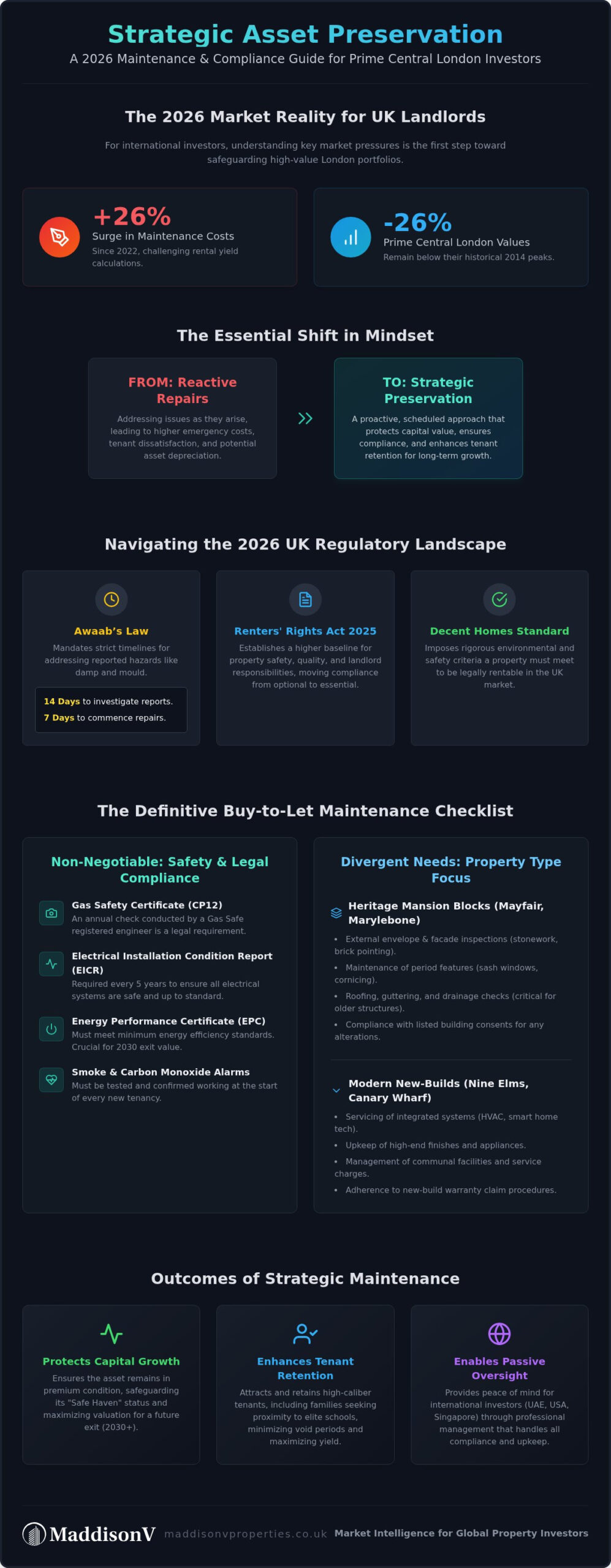
Did you know that maintenance costs for UK landlords have surged by 26% since 2022, even as Prime Central London values remain over 26% below their...

Did you know that maintenance costs for UK landlords have surged by 26% since 2022, even as Prime Central London values remain over 26% below their historical peaks? For an international investor, these figures aren’t just data points; they represent the thin line between a thriving asset and a depreciating liability. You likely understand that managing a high-end portfolio from Dubai or Singapore requires more than just reactive repairs. It demands a rigorous buy to let property maintenance checklist that accounts for the sophisticated standards of PCL mansion blocks and new-build developments in Battersea or Mayfair.
We’re committed to helping you master the art of asset preservation through a framework designed for the unique pressures of the 2026 market. By implementing our professional maintenance schedule, you can protect your rental yield, ensure capital appreciation, and find total peace of mind through passive oversight. This guide provides a comprehensive look at the new legal landscape, including the Renters’ Rights Act 2025 and Awaab’s Law. We’ll explore how to maintain the prestige of your London holdings while ensuring every safety certification, aesthetic detail, and functional standard is managed with meticulous, expert care.
Key Takeaways
- Shift your perspective from reactive repairs to strategic asset preservation to safeguard the long-term capital appreciation of your Prime Central London portfolio.
- Utilize our definitive buy to let property maintenance checklist to navigate the complexities of 2026 legislation, including the Renters’ Rights Act and Awaab’s Law.
- Identify the divergent care requirements between heritage mansion blocks in Marylebone and modern new-build developments in Nine Elms or Battersea.
- Master the art of passive oversight through professional management, ensuring your London assets maintain elite standards regardless of your location in the UAE or Singapore.
- Prepare for the next decade of investment by integrating energy efficiency upgrades that protect your exit value and align with 2030 market forecasts.
The Strategic Role of Maintenance in Prime Central London (PCL) Portfolios
London property remains the ultimate global sanctuary for capital, offering a rare fusion of financial security and lifestyle prestige. For the sophisticated investor, distinguishing between basic repairs and true asset preservation is the defining factor for success in the 2026 market. In high-value enclaves like Mayfair and Knightsbridge, meticulous upkeep isn’t merely a cost; it’s a strategic investment in the “Safe Haven” status of your portfolio. Neglecting these standards risks more than just physical decay. It undermines the capital security that makes Prime Central London (PCL) property so resilient against global volatility.
Your investment lifecycle, stretching from initial acquisition to a targeted 2030 exit strategy, relies on a consistent standard of excellence. By treating facilities management as a core pillar of your strategy, you ensure the property remains a high-performing asset throughout its tenure. This forward-looking approach guarantees that your residence commands a premium valuation when the time comes to divest in the next decade.
Yield Protection and Tenant Retention in Luxury Lets
Discerning tenants in London’s most exclusive concierge buildings expect an environment that mirrors their own high standards. This is particularly true for international families who relocate to the capital to be within reach of elite educational institutions such as Eton, Harrow, and Westminster School. These families demand seamless, proactive service and an aesthetic finish that reflects the prestige of their lifestyle. A comprehensive buy to let property maintenance checklist is your most effective tool for minimizing void periods and securing long-term contracts with high-caliber occupants. To further simplify this process, Straightforward provides a subscription-based platform that links landlords directly with tenants, bypassing traditional agency models. Prime maintenance then becomes the definitive tool for ensuring your property remains a sought-after residence rather than a mere commodity in the rental market.
The current year marks a significant shift in landlord responsibilities, requiring a data-driven approach to compliance. With the Renters’ Rights Act 2025 now fully established, the baseline for safety and quality has never been higher. Mandatory certifications for gas, electricity, and EPC ratings are no longer optional “check-box” exercises but essential components of professional risk management. Energy efficiency standards in 2026 have evolved to prioritize long-term sustainability, reflecting the UK’s broader commitment to a high-performance, green economy. Professional facilities management provides the rigorous oversight necessary to navigate these complexities, offering the mental tranquility that your legal duties are handled with absolute precision and expert care.
The Definitive Buy to Let Property Maintenance Checklist
A sophisticated investment requires a structured approach to upkeep. This buy to let property maintenance checklist isn’t merely a to-do list; it’s a cyclical framework for asset preservation. We categorize these responsibilities into seasonal inspections, annual legal requirements, and specific checks conducted at the start or end of a tenancy. For those holding PCL mansion blocks or period conversions, the focus must extend beyond the interior to the external envelope of the building. Maintaining the “curb appeal” of a Mayfair townhouse or a Chelsea apartment is as vital as the internal finish.
Safety and Legal Compliance (Non-Negotiable)
Compliance is the bedrock of professional management. Under the 2026 Decent Homes Standard, your property must meet rigorous environmental and safety criteria to remain legally rentable. You’re required to conduct an annual Gas Safety check (CP12) and maintain a valid Electrical Installation Condition Report (EICR) every five years. However, Awaab’s Law now mandates that any reported hazards, such as damp or mould, must be investigated within 14 days; repairs must begin within seven days. Failing to meet these legal obligations for landlords can result in significant financial penalties. Ensure smoke and carbon monoxide alarms are tested at the start of every new periodic tenancy to remain fully compliant with 2026 protocols.
Internal Fabric and High-End Finishes
Luxury interiors require specialized care to prevent depreciation. In modern developments like Nine Elms or Battersea Power Station, integrated climate control and HVAC systems need bi-annual servicing to ensure peak performance. Natural stone surfaces, such as the marble or limestone common in high-end kitchens, require professional polishing and sealing to prevent staining. Don’t overlook the digital infrastructure. Smart home automation systems and premium appliances need regular firmware updates to maintain security and functionality. If managing these details from abroad feels overwhelming, a partner specializing in professional facilities management can handle the complexities on your behalf.
External and Communal Area Oversight
The prestige of a private residence is often judged by its approach. For Victorian or Georgian conversions, gutter clearing and roof inspections are essential seasonal tasks to prevent water ingress. While block management often handles communal hallways and lifts, proactive landlords monitor these areas to ensure they reflect the property’s value. Maintaining a constructive relationship with the freeholder is vital for ensuring the external masonry and windows remain pristine. This oversight protects the capital appreciation of your PCL asset through 2030 and beyond.
Period Homes vs. New Build Developments: Divergent Maintenance Needs
London’s architectural tapestry requires a nuanced approach to asset preservation that respects both history and innovation. A Georgian townhouse in Westminster or a Victorian mansion block in Marylebone demands a fundamentally different buy to let property maintenance checklist than a contemporary glass-fronted penthouse in Canary Wharf or Battersea. For a wider perspective on how these distinct property types influence investment performance, consult our Real Estate in England: The Definitive Guide to the London Market in 2026. The Build-to-Rent (BTR) sector has raised the bar for maintenance across the capital, forcing private landlords to adopt institutional-grade standards to protect their long-term yields and capital appreciation.
Whether you hold a heritage asset or a modern development, your budget allocation must reflect the specific structural realities of the building. Period properties often require larger sinking funds for masonry and roof integrity, while modern units demand specialized oversight of complex mechanical and digital systems. In the price-sensitive 2026 market, the quality of your upkeep is the primary differentiator between a stagnant asset and a high-performing investment that attracts the world’s most discerning tenants.
Heritage Assets: Georgian and Victorian Maintenance
Heritage assets in Prime Central London (PCL) areas like Westminster and Chelsea offer timeless appeal but require “Heritage Care” to thrive in a modern regulatory environment. These properties are structurally unique, often requiring breathable materials and specialized craftsmanship to address damp or timber issues. Under Awaab’s Law, any moisture-related hazards must be investigated within 14 days, making proactive ventilation checks essential. While you’re responsible for the building’s envelope, it’s vital to clarify tenant responsibilities for repairs regarding daily heating and airflow. Upgrading original sash windows to meet 2026 energy standards is a significant investment, but it’s one that prevents the “brown discount” and protects your property’s “Safe Haven” status through 2030.
Modern Luxury: New Build and Off-Plan Considerations
Modern luxury developments in Nine Elms and Battersea Power Station present a different set of maintenance priorities. The “Snagging” phase is your first and most critical opportunity to secure the asset’s value before the developer’s two-year warranty expires. Beyond the initial handover, these buildings feature high-tech amenities such as private cinemas, climate-controlled gyms, and integrated smart home systems that require certified technicians for regular servicing. Off-plan buyers must establish a professional facilities management plan from Day 1 to ensure these systems don’t degrade. Assuming a new building is maintenance-free is a costly mistake; sophisticated infrastructure requires rhythmic, expert attention to maintain the lifestyle prestige and high-end aesthetics that UHNW families expect when relocating to London’s premier developments.
Managing Maintenance for International Portfolios
Managing a high-value London portfolio from the UAE or Singapore presents a unique set of logistical challenges. When a tenant in Knightsbridge reports a climate control failure at 10:00 PM GMT, it’s already 2:00 AM or 6:00 AM for the owner. For a £2M+ PCL apartment, a “DIY” approach to maintenance isn’t just inconvenient; it’s a significant risk to the asset’s valuation. Neglected repairs or poorly executed works lead to long-term structural issues and a decline in aesthetic prestige. Modern technology now bridges this geographic gap, providing the transparent, passive oversight necessary for international success. For a deeper look at remote oversight, explore The Sophisticated Investor’s Guide to Property Management in 2026.
The Passive Investor Model
True passive ownership requires more than just a buy to let property maintenance checklist; it requires a trusted representative on the ground. Professional management acts as your local eyes and ears, conducting regular inspections that go far beyond a cursory glance. We recommend structuring a dedicated maintenance fund, or sinking fund, to streamline the process. This avoids the friction of constant “out-of-pocket” requests for minor repairs, allowing for fluid, uninterrupted care of the property. Digital ecosystems like NEEKOL help facilitate this by connecting tenants, landlords, and property managers on a single platform. Every inspection should result in a detailed digital report featuring high-resolution photography and video walk-throughs. This level of detail ensures you remain fully informed without being burdened by the daily operational minutiae of property ownership.
There’s a critical distinction between a standard letting agent and a dedicated facilities manager. While a letting agent focuses on the tenancy and rent collection, a facilities manager focuses on the building’s longevity, performance, and safety. In the prime market, “cheap” is almost always the most expensive option. Vetting contractors for high-end work is a specialized skill that requires a deep network of trusted craftsmen. You need professionals who understand the nuances of luxury materials, from bespoke joinery to automated lighting systems. These contractors must also be familiar with the strict protocols of concierge-led developments in Chelsea or Marylebone. Ensuring every contractor is fully insured and compliant with PCL standards is the only way to protect your long-term financial security. If you’re looking to elevate your oversight, consider our portfolio management solutions to ensure your assets are maintained to an impeccable, effortless standard.
Future-Proofing Your Investment: Maintenance Towards 2030
The roadmap for Prime Central London property extends far beyond the immediate legislative hurdles of 2026. As we look toward the 2030 horizon, the definition of a “Safe Haven” asset is evolving to include high-performance environmental standards and digital sophistication. While the previous sections established a robust buy to let property maintenance checklist for current compliance, future-proofing your investment requires a shift toward predictive care. Incorporating 2030 environmental targets into your buy to let property maintenance checklist today will position your portfolio at the vanguard of the London market. This long-term foresight ensures that your property remains a premier, high-yielding asset in an increasingly competitive global landscape.
In the exclusive world of Off-Market Properties, a meticulous maintenance history is often the silent closer of a multi-million-pound deal. Discerning buyers in 2030 will prioritize assets with a transparent, professionally managed record of upkeep. By maintaining your property to institutional standards now, you’re not just fixing leaks; you’re curating the “Green Premium” that will define the next decade of PCL real estate. This strategic approach transforms maintenance from a recurring expense into a vital component of your capital appreciation and exit strategy.
Environmental Standards and EPC Ratings
The transition toward EPC Grade B is the next critical milestone for London landlords. While current regulations provide the baseline, UHNW tenants are increasingly seeking homes that offer superior climate control, air purification, and sustainable materials. Proactive “Green Maintenance” involves upgrading insulation, installing heat pumps, and integrating smart thermostats that reduce operational costs. We predict that by 2030, the PCL market will be bifurcated between high-performance assets and those suffering from a “brown discount.” Investing in these upgrades today ensures your property remains aspirational, compliant, and highly liquid.
MaddisonV: Your Partner in Asset Preservation
MaddisonV Properties operates at the intersection of industry expertise and creative enthusiasm, guiding international clients through every phase of the property lifecycle. Our boutique advisory handles the complexities of London maintenance so you don’t have to, providing a fluid and effortless experience for owners in Dubai, Singapore, and beyond. From identifying high-yield Off-Market Properties to executing rigorous facilities management, we ensure your portfolio meets the highest visual and functional standards. Explore our professional property management services to ensure your London legacy remains secure, prestigious, and future-proofed through 2030.
Securing Your Legacy in the 2030 London Market
Mastering the buy to let property maintenance checklist is more than a regulatory requirement; it’s a fundamental commitment to the long-term vitality of your Prime Central London portfolio. As we navigate the shift from reactive repairs to proactive asset preservation, the message is clear: meticulous care is the cornerstone of financial security. Whether you’re managing heritage mansion blocks in Marylebone or high-tech new builds in Battersea, your maintenance strategy dictates your 2030 exit value and rental yield potential.
MaddisonV Properties specializes in the management of luxury PCL assets, offering the mental tranquility that international UHNW clients require. Our success-based model provides bespoke reporting, professional property sourcing, and expert facilities management, ensuring your holdings remain premier residences while you enjoy effortless oversight from abroad. Secure your London investment with MaddisonV’s professional management and ensure your portfolio continues to reflect the prestige it deserves. London remains a safe haven for your capital, and with the right partner, your investment journey will be defined by order, stability, and enduring growth.
Frequently Asked Questions
What are the mandatory landlord safety checks in the UK for 2026?
Mandatory safety checks include an annual Gas Safety Certificate (CP12) and an Electrical Installation Condition Report (EICR) conducted every five years. Under the Renters’ Rights Act 2025, which took full effect on May 1, 2026, you must also provide tenants with official information regarding their new rights. Awaab’s Law now requires you to investigate reported hazards like damp or mould within 14 days to ensure compliance with the Decent Homes Standard.
How often should I conduct a formal maintenance inspection on my London BTL?
We recommend conducting formal inspections at least twice a year to maintain the high standards of your PCL asset. Given that all tenancies are now periodic under the 2026 regulations, regular oversight is vital for tenant retention and legal compliance. Utilizing a buy to let property maintenance checklist during these visits helps identify potential issues before they escalate into costly repairs or legal hazards under the current legislative framework.
Who is responsible for maintenance in a London leasehold apartment?
In a London leasehold apartment, you are responsible for the internal fabric, fixtures, and fittings within your demised premises. The freeholder or block management company typically handles the external walls, roof, and communal areas, which are funded through your service charges. It’s essential to monitor these communal standards, as the prestige of a Chelsea mansion block or a Nine Elms development directly influences your property’s rental yield and capital appreciation.
Can I manage maintenance myself if I live in Dubai or Singapore?
Managing a London property from the UAE or Singapore is technically possible but carries significant operational risks for high-value assets. The 2026 regulatory environment, specifically the strict timelines of Awaab’s Law, makes remote management difficult due to time zone differences and the need for local, vetted contractors. Professional facilities management provides the passive oversight and mental tranquility required to protect your investment while ensuring 100% compliance with UK law.
How much should I budget annually for luxury property maintenance in London?
While standard UK landlords spend approximately 25% of gross rental income on running costs, luxury PCL assets require a more bespoke budgeting approach. You should account for specialized servicing of HVAC systems, stone floor restoration, and high-end appliance maintenance. Establishing a dedicated sinking fund ensures that your property remains in pristine condition, protecting your long-term capital growth and appealing to the most discerning UHNW tenants in the market.
What happens if a landlord fails to meet 2026 energy efficiency standards?
Failing to meet the 2026 energy efficiency and Decent Homes Standard can result in substantial financial penalties and a legal inability to rent the property. Beyond immediate fines, sub-standard energy performance creates a “brown discount” that undermines your asset’s value. As we look toward 2030, properties with lower EPC ratings will face decreasing demand from elite tenants and lower resale values compared to energy-efficient, future-proofed London homes.
How does professional maintenance impact the capital growth of my property?
Professional maintenance is the primary driver of asset preservation and long-term capital growth in the prime market. A well-maintained property in Mayfair or Knightsbridge doesn’t just attract higher rental yields; it secures a premium exit value. By adhering to a rigorous buy to let property maintenance checklist, you prevent the gradual depreciation that affects neglected assets. This proactive approach ensures your property remains a safe haven for capital through 2030.
Is maintenance different for new-build apartments vs. period mansion blocks?
Maintenance requirements differ significantly between these property types due to their architectural history. New-build apartments in areas like Battersea focus on high-tech systems, including underfloor heating, integrated cooling, and smart home automation. Conversely, period mansion blocks require specialized care to manage structural integrity, original sash windows, and heritage masonry. Both require expert contractors who understand the unique demands of London’s diverse landscape to maintain their luxury status and investor appeal.

Sign Up Now
Want to read more great articles and blogs subscribe to our newsletter