
With foreign investment in Dubai's real estate hitting a staggering AED 148.35 billion in the first quarter of 2026, the city has firmly established...

With foreign investment in Dubai’s real estate hitting a staggering AED 148.35 billion in the first quarter of 2026, the city has firmly established itself as a global liquidity powerhouse. Yet, for many sophisticated investors, the path to securing dubai property investment financing for foreigners still feels unnecessarily opaque. You’ve likely felt the tension of balancing high-leverage debt against currency fluctuations, or perhaps you’re weighing the stability of a Knightsbridge townhouse against the high-yield potential of a Dubai luxury development. It’s a complex challenge to manage debt across borders while maintaining the prestige and lifestyle you expect.
It’s understandable to feel cautious when facing non-resident lending regulations that can appear intricate and layered. We’re here to provide the clarity you need to move forward with quiet confidence. This guide will help you master high-leverage financing, explaining how to secure LTV ratios of up to 65% while integrating these assets into a global wealth strategy that prioritizes security, liquidity, and growth. We’ll analyze the 2026-2030 market forecast, compare debt structures between London and Dubai, and show you how to turn property debt into a refined tool for portfolio expansion. You’ll gain a clear roadmap for the effortless oversight of your international real estate holdings.
Key Takeaways
- Discover how the Dubai mortgage market has matured into a sophisticated credit environment, offering a secure safe haven for international capital through the 2030 forecast cycle.
- Identify the specific 2026 LTV ratios and income thresholds required to successfully secure dubai property investment financing for foreigners.
- Analyze the financial nuances of developer-led post-handover payment plans versus traditional bank mortgages for luxury off-plan acquisitions.
- Compare the long-term tax efficiencies and interest rate trends between the UAE and Prime Central London markets to refine your global wealth strategy.
- Learn how bespoke mortgage consultations can bypass institutional hurdles to seamlessly integrate high-value Dubai assets into a prestigious investment portfolio.
The Evolution of Dubai’s Mortgage Market for International Investors in 2026
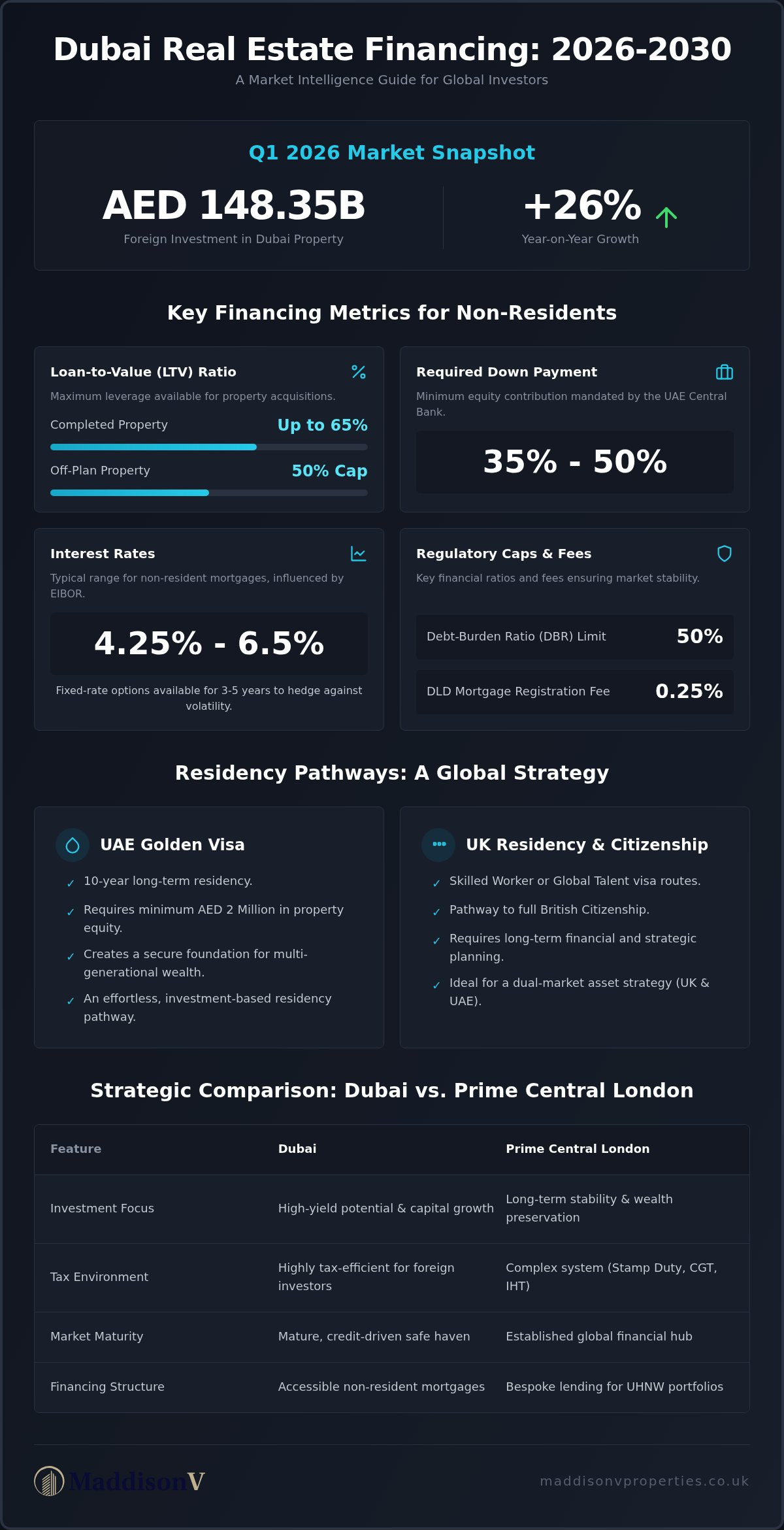
The landscape of Real estate in the United Arab Emirates has undergone a profound transformation, moving far beyond its historical reputation as a cash-only market. In 2026, we’re seeing a mature, credit-driven environment where sophisticated debt instruments are the standard for wealth preservation. During the first quarter of 2026 alone, foreign investment reached AED 148.35 billion, a 26% increase that reflects the city’s status as a premier safe haven for global capital. This stability is bolstered by the 10-year Golden Visa, which grants long-term residency to those investing at least AED 2 million in property equity, creating a secure foundation for multi-generational portfolio growth through 2030.
While Dubai’s Golden Visa provides an effortless residency pathway, many of our clients maintain a dual-market strategy by utilizing UK residency routes. For those balancing assets between the UAE and London, understanding how a property portfolio supports applications for the Skilled Worker or Global Talent visas is essential. These pathways, which often culminate in British Citizenship, require a different level of long-term financial planning than the UAE’s investment-based residency. MaddisonV Properties acts as the bridge between these two worlds, providing the market intelligence necessary to manage debt across jurisdictions that offer vastly different lifestyle and residency rewards.
To better understand the mechanics of securing these loans as an overseas buyer, watch this helpful overview:
In the current UAE context, a Non-Resident Mortgage is defined as a bespoke financing facility provided to international investors who don’t hold UAE residency, offering structured leverage that typically requires a down payment of 35% to 50% to align with Central Bank risk mandates. This evolution allows UHNW individuals to treat dubai property investment financing for foreigners with the same financial rigor they apply to Prime Central London acquisitions. The market’s transparency now mirrors that of the world’s most established financial hubs, providing the mental tranquility required for high-stakes international investment.
2026-2030 Market Forecast and Interest Rate Trends
Current interest rates for non-residents generally range from 4.25% to 6.5%, largely influenced by global EIBOR shifts. While variable rates offer flexibility, many of our clients are opting for fixed-rate products for three to five years to lock in predictable financing costs. This stability is crucial when forecasting rental yields in high-demand districts, where capital growth continues to outpace many Western markets. By securing fixed-rate debt now, investors can insulate their portfolios against mid-term volatility while benefiting from the projected upward trajectory of the 2030 market cycle.
Regulatory Safeguards for Foreign Borrowers
Transparency and order are maintained through the rigorous oversight of the Dubai Land Department (DLD). When pursuing financing, you’ll encounter a standardized mortgage registration fee of 0.25% of the loan amount, ensuring your legal interests are protected. Current regulations cap the Loan-to-Value (LTV) ratio at 50% for off-plan properties, a mandate designed to prevent the over-leverage seen in previous decades. These safeguards, combined with the UAE Central Bank’s 50% Debt-Burden Ratio (DBR) limit, ensure that every acquisition contributes to a balanced, resilient, and prestigious global estate.
Navigating Eligibility: LTV Ratios and Non-Resident Requirements
Securing high-leverage financing in 2026 requires a nuanced understanding of the UAE Central Bank’s evolving framework. For international buyers, the landscape of dubai property investment financing for foreigners is defined by a rigorous yet rewarding eligibility process. Unlike local residents who might access 80% leverage, non-resident investors typically navigate a Loan-to-Value (LTV) cap between 50% and 65%. This requires a strategic approach to liquidity, especially when acquiring prime assets in neighborhoods like Mayfair or Knightsbridge while simultaneously expanding into Dubai’s high-yield districts. It’s a balance of capital preservation and ambitious growth that defines the modern UHNW portfolio.
Obtaining an ‘Approval in Principle’ (AIP) is an essential first step in the dubai property investment financing for foreigners process, as it allows you to move with the speed and precision that the 2026 market demands. An AIP provides the quiet confidence needed to negotiate with developers and sellers, signaling your status as a verified, serious contender. Most lenders require a minimum monthly income of AED 15,000 for non-residents, though UHNW applicants are often assessed on a more holistic basis. Because the UAE Dirham (AED) remains pegged to the US Dollar, global investors benefit from a predictable debt environment, allowing for fluid portfolio management across different currencies without the immediate anxiety of exchange rate volatility.
Documentation for Global Income Verification
Lenders in 2026 demand a meticulous audit of global income streams to ensure financial stability. Salaried investors must provide six months of original bank statements and pay slips, while self-employed individuals are required to present two years of audited company accounts. This is where the expertise of UK-based advisors becomes invaluable. They bridge the gap between Western accounting standards and UAE bank requirements, ensuring that complex tax returns and cross-border dividends are presented with the clarity that institutional underwriters require. This rhythmic, detail-oriented preparation is the hallmark of a successful application. You’ll find more context in this Forbes Guide to Dubai Real Estate regarding the broader purchasing journey.
The 35% Down Payment Reality
While local expats enjoy lower entry barriers, non-residents must prepare for a minimum 35% down payment on ready properties, which can rise to 50% for off-plan acquisitions. This entry threshold is a deliberate safeguard for market stability, but it can create temporary liquidity gaps for investors with capital tied up in PCL mansion blocks or Canary Wharf developments. To optimize your entry, consider leveraging existing equity in your London portfolio to fund your Dubai deposits. This allows you to maintain your UK footprint while capturing the tax-free growth of the UAE market. For those looking to navigate these complexities with ease, our bespoke mortgage consultations offer a direct path to high-tier financing solutions that respect your time and your global wealth strategy.
Financing Luxury Off-Plan Developments: A Strategic Analysis
The strategic acquisition of luxury off-plan apartments Dubai requires a nuanced choice between developer-led post-handover payment plans and institutional bank leverage. In 2026, many UHNW investors utilize these payment plans as interest-free credit, allowing capital to remain liquid for other high-value opportunities. However, for those looking to maximize their footprint, traditional bank financing offers longer tenures and the ability to lock in rates that hedge against future EIBOR fluctuations. MaddisonV Properties ensures that your debt structure is as refined as the asset itself, balancing immediate entry costs with long-term portfolio stability.
The 2026 Phased Financing model allows investors to secure initial credit for construction milestones while deferring the principal mortgage commitment until the property achieves its Building Completion Certificate. This rhythmic approach to capital deployment is supported by the UAE’s rigorous escrow account protections, which mirror the security found in Prime Central London acquisitions. By aligning your dubai property investment financing for foreigners with these construction phases, you ensure that your capital is only committed as the asset gains tangible value, providing a layer of financial security that is paramount for international buyers.
Leveraging Off-Plan for Capital Appreciation
Timing your financing to match construction milestones is critical for maximizing capital appreciation before the final handover. In the 2026 cycle, we’ve seen aggressive growth in districts like Dubai Creek Harbour, which offers a contrasting appreciation curve to the steady, reliable returns of modern developments in Nine Elms. For investors utilizing a ‘Flip’ strategy, financing considerations must account for pre-completion sale clauses, ensuring that the debt can be settled or transferred seamlessly. This forward-looking perspective allows you to capture the market peak while maintaining the agility required for a global investment strategy.
Mortgage Options for Ready-to-Move Luxury Assets
For families seeking immediate lifestyle prestige, financing ready-to-move assets requires a different analytical lens. While Dubai’s modern mansion blocks offer high-end aesthetics and fluid processes, many of our clients compare these to the architectural history of London’s Georgian and Victorian homes in Mayfair and Knightsbridge. Financing for these heritage assets often hinges on their proximity to elite educational institutions like Eton, Harrow, and Westminster School. Whether you’re securing a contemporary villa in Dubai or a historic London residence, MaddisonV Properties ensures that the valuation nuances reflect the true lifestyle benefits, providing the mental tranquility and effortless oversight you expect from a premium partner.
Strategic Leverage: Comparing Dubai and London Financing Models
Sophisticated investors in 2026 don’t view London and Dubai as competitors; they see them as complementary pillars of a resilient global estate. While London’s institutional Build-to-Rent sector provides stable, inflation-linked returns in established postcodes like Canary Wharf, Dubai offers a high-velocity yield arbitrage that’s increasingly accessible through structured debt. The core of this comparison lies in the interest rate differential. In 2026, the UAE EIBOR typically tracks the US Federal Reserve’s trajectory, while the UK Base Rate responds to domestic inflationary pressures. This creates a strategic opportunity to release equity from a stable London asset to fund a high-yield acquisition in the UAE. Navigating these multi-jurisdictional complexities requires the specialized insight of property sourcing agents London who understand both markets’ financial rhythms.
The entry costs also present a stark contrast that influences dubai property investment financing for foreigners. In the UK, Stamp Duty Land Tax for non-resident investors on additional properties can be substantial, often exceeding 15% for high-value Prime Central London (PCL) acquisitions. Conversely, Dubai maintains a flat 4% transfer fee, which is frequently split between buyer and seller or covered by developers in luxury off-plan deals. This lower barrier to entry allows for more efficient capital deployment, enabling you to secure a larger footprint for the same initial outlay. Balancing these two models ensures your portfolio remains liquid, diverse, and prestigious through the 2030 cycle.
Taxation and Inheritance Considerations
A primary driver for diversifying financing into the UAE is the zero-tax environment on rental income and capital gains. While the UK remains a premier safe haven, potential tax reforms in 2026 have made investors more conscious of their global tax liability. Holding debt in Dubai can be a strategic way to manage inheritance tax planning, especially when assets are structured through a combination of UAE foundations and UK trusts. Financing choices in one region often have a rhythmic impact on the tax efficiency of the other. It’s essential to structure your debt to minimize exposure while maximizing long-term wealth transfer for your family.
Safe Haven Status and Currency Pegs
The stability of the AED/USD peg remains a cornerstone of financial security for international debt servicing. It provides a level of mental tranquility that’s hard to find in other emerging markets, ensuring your mortgage payments remain predictable regardless of regional shifts. London’s resilience in the face of 2026 market shifts continues to attract capital, but the ability to diversify debt across two safe havens mitigates geopolitical risks. By leveraging our expertise, you can navigate these complex cross-border requirements with quiet confidence. To explore how these models can be tailored to your goals, we invite you to book a bespoke mortgage consultation with MaddisonV Properties.
Bespoke Mortgage Consultations for High-Net-Worth Portfolios
While institutional banks often promise a dedicated relationship manager, they’re frequently restricted by their own internal product suites and rigid underwriting criteria. MaddisonV Properties operates with an air of quiet confidence, providing independent mortgage consultations that prioritize your specific financial security over institutional bias. We specialize in securing competitive rates for non-resident UHNW clients by leveraging deep-rooted developer partnerships and private banking networks. This independent approach allows us to source off-plan property investment opportunities that come with pre-approved financing, effectively removing the friction from your acquisition journey. We handle the clinical management of your debt so you can focus on the rewards of a high-tier lifestyle.
Managing debt is only one component of a successful portfolio; integrating that debt into a comprehensive property management strategy is what ensures long-term yield and mental tranquility. MaddisonV Properties provides a fluid process where financing, sourcing, and oversight coexist under one professional umbrella. By aligning your dubai property investment financing for foreigners with a professional management model, we protect the functional and aesthetic standards of your assets. This holistic view ensures that your leverage works in harmony with your rental income, providing a stable and rhythmic return on your capital through the 2030 market cycle.
Navigating the Conveyancing and Legal Lifecycle
Opening a UAE bank account as a non-resident is a prerequisite for mortgage servicing, and we guide you through this requirement with meticulous precision. For our international clients based in London or Singapore, the role of Power of Attorney (POA) is central to closing financing remotely. This legal tool allows for the seamless execution of documents without the need for frequent travel, ensuring that your time remains your own. Once the asset is secured, our facilities management services take over to ensure the property remains in peak condition, maintaining the high-yield status of your financed investment. We bridge the gap between complex operational details and a superior user experience, where you can also explore Vehicle Rental and Transportation Services to manage your local mobility with the same level of prestige as your property portfolio.
Moving toward your 2030 wealth goals requires meticulous planning and grounded expertise today. Conducting rigorous due diligence on developers and financing partners is the first step in ensuring your capital remains in a safe haven. We recommend preparing a comprehensive ‘Investor Pack’ including verified income statements and global asset disclosures to facilitate a 60-minute approval in principle. This preparation gives you the agility to act on off-market opportunities in Mayfair or Dubai with equal speed. Booking a bespoke consultation with MaddisonV Properties is the most effective way to align your financing with your broader aspirations for prestige, growth, and effortless oversight.
Securing Your Global Legacy through 2030
Dubai’s transition into a mature credit environment has turned debt into a refined tool for sophisticated wealth expansion. By mastering LTV ratios and timing your leverage with construction milestones, you can build a resilient portfolio that bridges the gap between London’s timeless postcodes and Dubai’s high-velocity growth. Navigating the intricacies of dubai property investment financing for foreigners no longer needs to be a source of anxiety. It’s a fluid, rhythmic, and sophisticated process that promises financial security, effortless oversight, and lifestyle prestige.
MaddisonV Properties acts as your premium partner throughout the entire property lifecycle. As specialists in PCL and Dubai luxury developments, we provide independent access to a global network of lenders to secure competitive terms tailored to your UHNW profile. Our commitment extends from initial sourcing to comprehensive property management, ensuring your assets remain high-yield and prestigious. Book Your Bespoke Mortgage Consultation Today to align your 2026 acquisitions with your long-term 2030 goals. We look forward to guiding your path with quiet confidence, integrity, and meticulous care.
Frequently Asked Questions
Can I get a mortgage in Dubai if I don’t live in the UAE?
Yes, international investors can secure financing without UAE residency. Many UAE banks offer specialized products for non-resident buyers who wish to expand their portfolios in the region. This allows you to acquire luxury assets in prestigious districts while maintaining your primary residence in London or Singapore. The process is designed to be fluid, secure, and professional, ensuring that distance is never a barrier to your investment ambitions or global wealth strategy.
What is the typical down payment for a non-resident mortgage in Dubai in 2026?
Non-resident investors typically prepare for a down payment ranging from 35% to 50% of the property value. This requirement is higher than for local expats to ensure market stability and financial security. While this entry threshold requires significant initial liquidity, it provides a solid foundation for your investment. It reflects the UAE Central Bank’s commitment to a safe, regulated, and orderly real estate market for all international participants looking for long-term growth.
How do Dubai interest rates compare to UK buy-to-let mortgages?
In 2026, Dubai interest rates for non-residents generally sit between 4.25% and 6.5%, often closely tracking the US Federal Reserve due to the currency peg. UK buy-to-let rates are subject to different inflationary pressures and Bank of England mandates. This creates a strategic arbitrage opportunity. Investors often find that the absence of income tax in Dubai makes these rates more attractive when calculating net rental yields compared to the high-tax environment of the UK.
Can I use rental income from a Dubai property to pay off my mortgage?
Yes, utilizing high rental yields to service your debt is a cornerstone of dubai property investment financing for foreigners. With average yields in luxury districts often exceeding those in Prime Central London, many investors find their assets become self-sustaining. This passive involvement allows for effortless oversight and mental tranquility. Professional property management ensures that your tenants are high-quality and your rental income remains consistent, reliable, and secure through the 2030 market peak.
Is it better to finance an off-plan property or a ready-to-move apartment?
The choice depends on your specific goals for capital growth or immediate income. Financing a ready-to-move apartment allows for higher leverage, often up to 65% LTV, and immediate rental returns. Off-plan properties are capped at 50% leverage but frequently offer interest-free developer payment plans. Both options provide customized solutions for sophisticated investors looking to secure high-tier standards in either modern new-builds or established mansion blocks across the city’s most prestigious postcodes.
What happens if I cannot keep up with repayments on my Dubai property?
UAE banks follow a structured legal process if repayments are missed, which can eventually lead to property foreclosure through the Dubai Land Department. However, lenders in 2026 are increasingly open to restructuring debt for UHNW clients experiencing temporary liquidity shifts. Maintaining open, professional communication is essential. Independent mortgage consultations help you structure your debt with sufficient buffers, ensuring your financial security remains intact and your global portfolio stays protected against unforeseen market shifts.
Does buying a property with a mortgage qualify me for the Dubai Golden Visa?
Yes, purchasing a property valued at AED 2 million or more qualifies you for the 10-year Golden Visa. If the property is mortgaged, you must demonstrate that at least AED 2 million of the property’s value has been paid to the developer or bank. This residency pathway offers a prestigious, secure, and long-term connection to the UAE, providing your family with lifestyle benefits and effortless access to one of the world’s most ambitious financial hubs.
Are there any hidden fees when securing a mortgage in Dubai as a foreigner?
Transparency is a priority in the 2026 market, though you should account for several standard costs. These include a mortgage registration fee of 0.25% payable to the Dubai Land Department and a property valuation fee typically between AED 2,500 and AED 3,500. Banks also charge a processing fee, usually around 1% of the loan amount. We ensure every detail is accounted for, providing a comprehensive, clear, and well-considered view of your dubai property investment financing for foreigners.

Sign Up Now
Want to read more great articles and blogs subscribe to our newsletter