Your Wimbledon investment block doesn't depreciate quietly. It deteriorates visibly, in peeling communal paintwork, in unresolved maintenance...

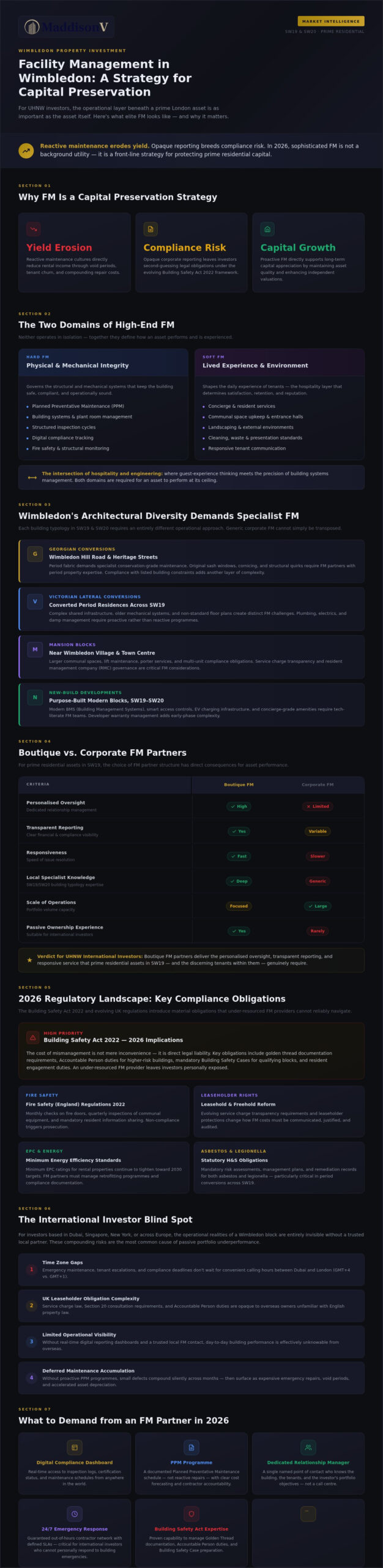
Your Wimbledon investment block doesn’t depreciate quietly. It deteriorates visibly, in peeling communal paintwork, in unresolved maintenance tickets, in tenants who leave rather than renew. For UHNW investors holding prime residential assets in one of London’s most coveted postcodes, the operational layer beneath the bricks matters as much as the bricks themselves. That’s precisely why sophisticated facility management in Wimbledon has shifted from a background utility into a front-line strategy for capital preservation.
You already know the risks. A reactive maintenance culture erodes yield. Opaque reporting from corporate managers leaves you second-guessing compliance. And with the UK’s building safety regulatory landscape continuing to evolve through 2026, the cost of mismanagement isn’t just inconvenience; it’s liability. These are the pressures that quietly undermine otherwise exceptional assets.
This guide addresses all of it. Drawing on the realities of Wimbledon’s prime residential market, it maps out what genuinely excellent facilities management looks like, how it directly supports tenant retention, long-term capital growth, and compliance confidence, and what to demand from any partner you trust with your portfolio.
Key Takeaways
- Sophisticated facility management Wimbledon investors rely on goes far beyond reactive maintenance — it is a structured, proactive strategy that directly protects yield, tenant retention, and long-term capital value in SW19 and SW20.
- Wimbledon’s architectural diversity, from Georgian conversions to modern new-builds, demands a specialist FM partner who understands how different building typologies require entirely different operational approaches.
- The UK’s evolving regulatory landscape, particularly the Building Safety Act 2022 and its 2026 implications, introduces material compliance obligations that UHNW investors cannot afford to delegate to an under-resourced corporate manager.
- Boutique FM partners offer a distinct advantage over large-scale corporate providers, delivering the personalised oversight, transparent reporting, and responsive service that prime residential assets — and the tenants within them — genuinely require.
- MaddisonV Properties integrates facilities management as a natural extension of its property sourcing and portfolio management expertise, providing international investors with a seamless, passive ownership experience across the full lifecycle of their Wimbledon asset.
The Strategic Importance of Facility Management in Wimbledon (SW19 & SW20)
Facilities management, in the context of London’s prime residential market, is considerably more than a maintenance schedule. It’s the operational architecture that determines whether a high-value asset performs at its ceiling or quietly underperforms beneath it. In SW19 and SW20, where discerning tenants expect standards that rival the best private members’ clubs, FM functions as the invisible infrastructure of capital preservation. Get it right, and the asset appreciates with purpose. Get it wrong, and yield erosion follows almost immediately.
Wimbledon’s residential stock spans an unusually broad typology. Georgian conversions on Wimbledon Hill Road sit within a short distance of contemporary mansion blocks near the Village, and purpose-built new-build developments occupy a different operational universe from Victorian lateral conversions. Each building type carries distinct mechanical systems, communal space configurations, and maintenance cadences. A facilities management approach calibrated for a Chelsea new-build cannot simply be transposed onto a Wimbledon period conversion without meaningful adaptation. Specialist local knowledge isn’t a premium add-on; it’s the baseline requirement.
The industry has also shifted decisively. Reactive repair cultures, where problems are addressed only after they surface, are being replaced by proactive asset management frameworks in 2026. Planned preventative maintenance programmes, digital compliance tracking, and structured inspection cycles are now the operational standard for prime residential blocks that intend to hold their value.
Wimbledon’s Evolving Residential Standards
Demand for concierge-led services in SW19 has risen in step with tenant expectations across prime South West London. High-quality communal environments, well-maintained entrance halls, landscaped external spaces, and responsive building management directly influence both tenant satisfaction and independent property valuations. Residential FM, at this level, is best understood as the intersection of hospitality and engineering: the discipline where guest experience thinking meets the precision of building systems management.
For residents, this seamless experience often relies on the management team’s ability to coordinate reliable London-wide support, such as 24/7 vehicle assistance from Creed Recovery, ensuring that every logistical detail is handled with professional precision.
Why International Investors Prioritise Local FM Expertise
For investors based in Dubai, Singapore, or New York, the operational realities of a Wimbledon block are entirely invisible without a trusted local partner. Time zone differences, unfamiliarity with UK leaseholder obligations, and limited visibility over day-to-day building performance create compounding risk. The UK’s ‘Safe Haven’ status as a property market is real, but it’s contingent on assets being actively protected.
This is precisely why facility management Wimbledon strategy connects directly to broader London property investment advisory thinking. The acquisition decision and the operational strategy are not separate disciplines; they’re two phases of the same commitment to long-term capital growth. Investors who treat FM as an afterthought are, in practice, leaving the most controllable variable in their return entirely unmanaged.
Core Components of High-End Residential Facility Management
Prime residential buildings are complex organisms. They contain layered mechanical systems, curated communal environments, and the daily expectations of tenants who chose Wimbledon precisely because of its standards. Understanding how the operational disciplines within facility management Wimbledon professionals deploy actually function, and how they interact, is the foundation of any serious asset preservation strategy.
The discipline divides cleanly into two interdependent domains: Hard FM, which governs the physical and mechanical integrity of the building, and Soft FM, which shapes the lived experience within it. Neither works in isolation. A building with flawlessly maintained plant rooms but neglected communal gardens communicates neglect. A beautifully presented entrance hall with an unreliable lift system undermines the very premium it attempts to project.
Hard FM: Protecting the Building’s Core
Hard FM encompasses the mechanical, electrical, and plumbing systems that keep a building functioning safely and efficiently. In luxury mansion blocks across SW19, this means active management of HVAC systems, passenger lift maintenance contracts, electrical distribution boards, water hygiene compliance, and fire suppression infrastructure. These systems don’t fail dramatically; they degrade incrementally, and the cost of that degradation compounds over time.
For heritage properties in Wimbledon Village, facade maintenance carries additional complexity. Period brickwork, sash windows, and original stonework require specialist contractors who understand conservation-grade materials and techniques. Applying standard repair methods to a Georgian elevation isn’t a cost-saving measure; it’s a liability. This commitment to quality extends to the interior, where bespoke solutions from Posner Interiors ensure that window dressings and shutters complement the building’s historic character.
Planned preventative maintenance (PPM) schedules are the operational instrument that separates proactive asset managers from reactive ones. A properly structured PPM programme anticipates component lifecycles, schedules interventions before failure, and creates a documented maintenance history that supports both insurance claims and future valuations. It’s methodical, unglamorous, and entirely essential.
Soft FM: Enhancing the Resident Experience
Soft FM is where the operational discipline meets the hospitality mindset. It covers security protocols, professional cleaning programmes, landscaped garden maintenance, concierge services, and the curation of communal aesthetics. In high-net-worth residential enclaves, these aren’t optional refinements; they’re the visible proof of management quality that tenants evaluate at the point of renewal.
Security deserves particular attention. Access control systems, CCTV management, and visitor protocols in premium Wimbledon developments require a calibrated approach that balances genuine protection with the discretion that UHNW residents expect. Overt security theatre is as damaging to the resident experience as insufficient coverage.
The connection between soft services and rental yield is direct. Tenants who experience consistent, high-quality communal environments, prompt responses, and a building that feels genuinely well-managed don’t simply renew; they advocate. Vacancy periods shorten. Rental premiums hold.
In 2026, smart building technology is reshaping both disciplines simultaneously. IoT-enabled sensors now allow building managers to monitor plant room performance remotely, detect water ingress before it becomes structural damage, and track energy consumption patterns across communal systems. This data layer doesn’t replace skilled facilities professionals; it makes them significantly more effective. Investors working with a specialist residential property management partner gain access to this operational intelligence without needing to interpret it themselves, which is precisely the passive ownership model that sophisticated international investors require.
Boutique vs. Corporate FM: Choosing the Right Partner in SW19
Scale is not a proxy for quality. In the context of facility management Wimbledon investors require, a provider’s portfolio breadth can actually work against the asset rather than for it. Large corporate FM operators are structured for efficiency across thousands of units; the operational model that makes them commercially viable is the same model that makes them structurally unsuited to the particularities of a boutique mansion block on Wimbledon Hill Road.
The distinction matters because prime residential assets are not interchangeable. They carry individual maintenance histories, specific leaseholder dynamics, and communal environments that reflect years of curatorial decisions. Applying a standardised service framework to an asset that demands a bespoke one isn’t a compromise; it’s a mismatch with measurable consequences.
The Pitfalls of One-Size-Fits-All Management
Generic service level agreements are written to protect the provider, not the asset. In the luxury residential sector, they typically define response times and task categories without accounting for the quality expectations that UHNW tenants hold as baseline standards. A corporate SLA might specify that a communal lighting fault is resolved within 48 hours; a discerning resident in SW19 experiences that gap as neglect, not process.
Hidden costs compound the problem. Corporate FM contracts frequently rely on national sub-contractor networks where margin is extracted at each layer of the supply chain. The result is inflated reactive maintenance costs, slower mobilisation, and contractors with no relationship to the building or its occupants. Local vendor networks, built over years of operational experience in a specific geography, deliver the opposite: faster response, competitive pricing, and tradespeople who understand the building’s character because they’ve worked in it before.
The risks of corporate distance extend further:
- Rotating account managers mean institutional knowledge is lost with every personnel change
- Portfolio-wide reporting templates obscure the nuance that individual asset owners need to make informed decisions
- Escalation hierarchies slow decision-making precisely when speed matters most
- Standardised procurement prioritises volume discounts over material quality appropriate for heritage or luxury stock
MaddisonV’s Approach to Exclusivity and Trust
Boutique FM operates on a fundamentally different premise: that the relationship between partner and investor is long-term, transparent, and built on direct access to the people making decisions. There are no account management tiers, no escalation queues. When a question arises about a Wimbledon asset, it reaches someone with both the authority and the contextual knowledge to act on it immediately.
This philosophy runs through everything outlined in the Sophisticated Investor’s Guide to Property Management, where the case for personalised, relationship-led management is made with the same clarity it deserves here. Meticulous attention to detail isn’t a marketing position; it’s the operational standard that prevents the small issues from becoming expensive ones.
For international investors, the practical value of this model is immediate. Facility management Wimbledon strategy, delivered through a boutique partner with integrated sourcing and portfolio management capabilities, means the asset is never operationally orphaned between disciplines. The same expertise that identified the acquisition opportunity remains engaged through every stage of ownership, ensuring that the investment performs as intended, quietly, consistently, and without demanding the investor’s constant attention.
2026 Compliance: Navigating the UK’s Regulatory Landscape
Regulatory complexity is no longer a background consideration for Wimbledon block owners. It’s a front-line operational reality. The Building Safety Act 2022 has reshaped the legal architecture of residential block management in the UK, and its 2026 implications are material. For investors holding higher-value assets in SW19 and SW20, understanding what these obligations actually require, not just that they exist, is the difference between protected capital and exposed liability.
The 2026 Building Safety Reforms
Under the Act, buildings over 18 metres or seven storeys are formally classified as Higher-Risk Buildings, triggering a distinct regulatory regime that demands structured accountability at every level. The Principal Accountable Person (PAP) carries legal responsibility for the safety case of the building, and that responsibility is not transferable through ignorance or delegation to an under-resourced management company. Landlords operating without a compliant safety case face enforcement action, remediation orders, and, in serious cases, criminal liability.
One of the Act’s most operationally significant requirements is the mandatory maintenance of a digital ‘Golden Thread’ of building information. This is a live, structured record encompassing design documentation, inspection histories, maintenance logs, and safety certifications, held in a format that regulators and residents can access. It’s not a filing exercise; it’s an ongoing discipline. The Golden Thread must be actively maintained, not assembled retrospectively when an inspection is imminent.
Resident engagement has also become a statutory obligation rather than a courtesy. Building owners are now required to implement formal strategies for consulting residents on safety matters, providing accessible information about building risks, and creating clear channels for raising concerns. For premium Wimbledon developments, this aligns naturally with the high-touch communication standards that discerning tenants already expect.
Alongside building safety, Health and Safety audit cycles remain non-negotiable. Fire risk assessments, Legionella control programmes, and asbestos management plans each carry their own compliance cadences. In period conversions, asbestos surveys require particular rigour. Legionella risk is live in any building with complex water systems. These aren’t tick-box exercises; they’re the documented evidence that protects investors if anything goes wrong.
ESG and Sustainability in Wimbledon FM
The path to Net Zero by 2030 is already shaping tenant expectations and EPC requirements simultaneously. Minimum EPC ratings for privately rented properties are subject to ongoing government review, and the direction of travel is unambiguous: assets with poor energy performance ratings will face both regulatory pressure and reduced tenant appeal. Proactive energy optimisation, covering communal lighting upgrades, insulation improvements, and building management system calibration, reduces service charge costs while strengthening the asset’s long-term position.
EV charging infrastructure has moved from a luxury amenity to a practical expectation in premium Wimbledon developments. Tenants arriving with electric vehicles who find no provision don’t simply inconvenienced; they reconsider the building entirely. Integrating EV charging during planned communal upgrades is considerably more cost-efficient than retrofitting it reactively.
Sustainable facility management Wimbledon investors can genuinely leverage is also a tenant acquisition tool. Eco-conscious professionals and families, a growing proportion of SW19’s rental demographic, actively factor environmental credentials into their decision-making. A building with a credible sustainability programme, visible through energy reporting, green communal spaces, and responsible procurement, commands both attention and loyalty.
Compliance, in 2026, is no longer separable from quality. The two disciplines have converged. Speak with MaddisonV Properties about how integrated facilities management keeps your Wimbledon asset fully compliant, operationally resilient, and positioned for long-term capital growth.
Bespoke Facility Management Solutions by MaddisonV Properties
Every discipline MaddisonV Properties brings to the Wimbledon market connects to a single governing principle: that exceptional assets deserve exceptional stewardship at every stage of ownership. From the moment an acquisition is identified through specialist property sourcing to the long-term operational management that protects and grows its value, the expertise remains consistent, the relationship remains direct, and the investor remains in control without being consumed by the detail.
This is the distinction that separates MaddisonV from providers who treat facilities management as a standalone contract. Here, FM is the natural continuation of the investment thesis, not a separate engagement with a separate team. The market intelligence that informed the acquisition decision continues to inform every operational choice, from planned maintenance scheduling to service charge benchmarking, ensuring the asset performs with the same precision that justified the purchase.
Integrated Portfolio Management
Combining facility management Wimbledon expertise with high-tier property management creates a coherence that neither discipline achieves alone. Financial reporting is transparent, granular, and structured around what investors actually need to see: expenditure against budget, maintenance histories, compliance status, and yield performance in a single consolidated view. There are no opaque cost centres, no unexplained contractor invoices, and no surprises at year-end.
For families relocating to SW19 for proximity to institutions such as King’s College School Wimbledon, the service extends naturally into the residential experience itself. Building environments that feel genuinely well-managed, secure, and beautifully maintained aren’t incidental to the family tenant’s decision to stay; they’re central to it. MaddisonV’s approach to communal standards, responsive communication, and curated building environments is calibrated precisely for this demographic, where the quality of the home environment reflects the quality of the life being built around it.
Your Next Steps in Prime South West London
2026 is the year to audit your current FM arrangements with genuine rigour. Regulatory obligations have sharpened. Tenant expectations have risen. And the gap between well-managed assets and under-managed ones is widening in ways that valuations are beginning to reflect. If your current provider can’t demonstrate a live compliance record, a structured PPM programme, and transparent financial reporting, the risk sits with you.
MaddisonV’s promise is straightforward: reliability, prestige, and the quiet confidence that comes from knowing your asset is in expert hands. No anxiety about what’s happening on the ground. No uncertainty about whether obligations are being met. Just a portfolio that performs.
Contact MaddisonV Properties for a bespoke FM consultation and discover what genuinely integrated, boutique facilities management looks like for your Wimbledon investment.
Protect What You’ve Built in SW19
Wimbledon’s prime residential market rewards investors who treat operational excellence as seriously as acquisition strategy. Facility management Wimbledon investors can genuinely rely on isn’t a passive contract; it’s the active discipline that keeps compliance obligations met, tenant relationships intact, and capital value moving in the right direction through 2026 and beyond.
Three things matter most. Specialist local expertise that understands SW19’s architectural diversity. Proactive compliance management aligned with the UK’s evolving Building Safety framework. And an integrated partner who sees your asset’s full lifecycle, not just isolated maintenance tickets.
MaddisonV Properties brings all three together. As specialists in Prime Central London assets, the firm provides comprehensive oversight designed specifically for international UHNW investors who expect their portfolio to perform without demanding their constant attention. Your Wimbledon investment deserves that standard of care.
Secure your Wimbledon assets with MaddisonV Properties’ professional facilities management and experience the quiet confidence that comes from knowing every detail is handled with precision.
Frequently Asked Questions About Facility Management in Wimbledon
What is the difference between property management and facility management in Wimbledon?
Property management focuses on the landlord-tenant relationship: rent collection, tenancy agreements, void periods, and lease compliance. Facility management addresses the physical building itself, covering mechanical systems, communal maintenance, safety compliance, and the day-to-day operational environment that residents experience. The two disciplines are complementary, not interchangeable.
In practice, the most effective approach integrates both. An investor whose property manager and facilities manager operate independently often finds gaps between the two, where maintenance issues affect tenancy renewals but nobody owns the connection. MaddisonV Properties combines both disciplines under one partnership, eliminating that operational blind spot entirely.
How does professional facility management impact the resale value of a luxury apartment?
A well-documented maintenance history, current compliance certifications, and a building in demonstrably good physical condition all support stronger independent valuations at the point of sale. Surveyors and buyers’ solicitors scrutinise service charge accounts, inspection records, and outstanding maintenance liabilities carefully. Buildings with gaps in any of these areas attract adjusted offers or extended due diligence periods.
Beyond the transactional moment, consistent facility management Wimbledon investors can rely on sustains the communal environment that justifies premium pricing in the first place. A building that has been reactively managed for several years before sale carries visible evidence of that neglect, in communal finishes, plant room condition, and the absence of structured maintenance records.
What are the specific 2026 compliance requirements for residential blocks in London?
The Building Safety Act 2022 introduced a tiered regulatory framework that became progressively more demanding through subsequent years. Buildings over 18 metres or seven storeys are classified as Higher-Risk Buildings, requiring a named Principal Accountable Person, a formal safety case, and an actively maintained Golden Thread of building information. Resident engagement strategies are also a statutory requirement, not an optional courtesy.
Separately, fire risk assessments, Legionella control programmes, and asbestos management plans each carry their own mandatory review cycles. Investors should verify that their current FM provider maintains live compliance records across all of these obligations, not just point-in-time certificates. We’d recommend consulting a qualified building safety professional or legal adviser to confirm how specific requirements apply to your individual asset.
Can MaddisonV Properties manage a small portfolio of individual luxury homes in SW19?
Yes. MaddisonV’s portfolio management and facilities management services extend to individual luxury homes as well as larger residential blocks across SW19 and SW20. The approach is calibrated to the specific asset type: a standalone luxury house requires a different operational framework from a mansion block, and the service reflects that distinction rather than applying a generic template.
For international investors holding two or three high-value properties in Wimbledon, integrated management across the portfolio provides consolidated reporting, consistent maintenance standards, and a single point of contact for all operational matters. That coherence is considerably more efficient than managing separate relationships with separate providers for each property.
How do you handle emergency maintenance for international owners?
International investors holding Wimbledon assets shouldn’t need to be reachable at 3am Singapore time to authorise a plumber. MaddisonV’s approach to facilities management is structured so that operational decisions within agreed parameters are handled directly, with clear communication to the owner once the situation is resolved rather than before it’s acted upon.
This is precisely the passive ownership model that sophisticated international investors require. Transparent reporting means you receive a clear account of what happened, what was done, and what it cost, without being drawn into the operational detail in real time. We’d encourage any prospective investor to discuss specific emergency protocols during their initial consultation to ensure the arrangement reflects their preferences.
What are the typical fees for facilities management in Prime Central London?
FM fees in prime London residential vary considerably depending on building size, the scope of services included, the complexity of mechanical systems, and whether hard and soft FM are bundled or contracted separately. Providing a figure here without knowing your specific asset would be misleading rather than helpful, and any provider quoting a standard rate before understanding your building should be treated with caution.
What matters more than the headline fee is what’s actually included and how costs are controlled. Transparent procurement, competitive tendering for contractor work, and clear service charge accounting protect investors from the hidden margin extraction that opaque corporate FM contracts frequently contain. Contact MaddisonV Properties directly for a bespoke assessment of your Wimbledon asset.
How do you integrate ESG and sustainability into older heritage buildings in Wimbledon?
Heritage buildings present genuine constraints: listed status, conservation area requirements, and original construction methods all limit which interventions are permissible. The practical approach focuses on the areas where improvement is both achievable and impactful. Communal LED lighting upgrades, improved insulation in accessible roof and floor voids, building management system optimisation, and smart metering for communal energy consumption are all compatible with heritage designations in most cases.
EPC improvement in older stock is a staged process rather than a single project. A credible sustainability programme for a Victorian or Edwardian Wimbledon building sets realistic targets, documents progress, and communicates improvements to tenants in a way that reinforces the building’s appeal to eco-conscious residents. That combination of genuine improvement and transparent reporting is what distinguishes a substantive ESG strategy from a superficial one.
Do you provide concierge and security services as part of your FM contracts?
Soft FM services, including security protocols, access control management, and concierge-style building oversight, form an integral part of MaddisonV’s facilities management offering for premium Wimbledon developments. These services aren’t bolted on as optional extras; they’re considered part of the resident experience that justifies the premium the building commands.
The specific configuration depends on the building and its occupants. A boutique mansion block with UHNW residents requires a calibrated approach that delivers genuine security without the overt presence that discerning tenants find intrusive. The right balance is established through an initial assessment of the building’s layout, existing infrastructure, and the expectations of current and prospective residents.

Sign Up Now
Want to read more great articles and blogs subscribe to our newsletter