
Did you know that while many mature markets struggle with stagnation, Dubai’s off-plan sector has surged by 12.22% year-on-year to reach an average...

Did you know that while many mature markets struggle with stagnation, Dubai’s off-plan sector has surged by 12.22% year-on-year to reach an average of AED 2,030 per square foot? For the sophisticated investor, identifying the best areas to invest in Dubai property in 2026 requires moving beyond surface-level aesthetics to interrogate the underlying data. You’re likely aware that opaque service charges and concerns over market oversupply can quickly erode your margins if left unchecked. Managing a high-value portfolio from London or Singapore demands a level of precision that balances capital appreciation with the reality of net returns.
This analysis provides a clear, data-driven roadmap to help you secure 7% plus net yields and leverage the transformative impact of the 2040 Urban Master Plan. We’ll explore why mid-market hubs like Jumeirah Village Circle are outperforming traditional luxury enclaves, and how the AED 2 million Golden Visa threshold remains a cornerstone of the city’s investment appeal. From the infrastructure shifts near Al Maktoum International Airport to the necessity of professional, hands-off management, this guide ensures your capital remains secure, productive, and prestigious.
Key Takeaways
- Benchmark Dubai’s 6% to 9% rental yields against traditional prime London assets to capitalise on a tax-efficient, high-cash-flow environment.
- Pinpoint the best areas to invest in Dubai property for 2026, focusing on high-performance residential hubs like Jumeirah Village Circle and Arjan.
- Navigate the complexities of the Dubai Land Department Service Charge Index and chiller fees to protect your net margins from hidden operational costs.
- Balance long-term capital growth with immediate rental returns by strategically selecting between off-plan opportunities and established secondary market assets.
- Secure a seamless, hands-off investment journey through MaddisonV Properties’ bespoke sourcing model and professional facilities management, tailored for overseas investors.
Benchmarking Dubai’s Performance: Global Yields and the 2040 Vision
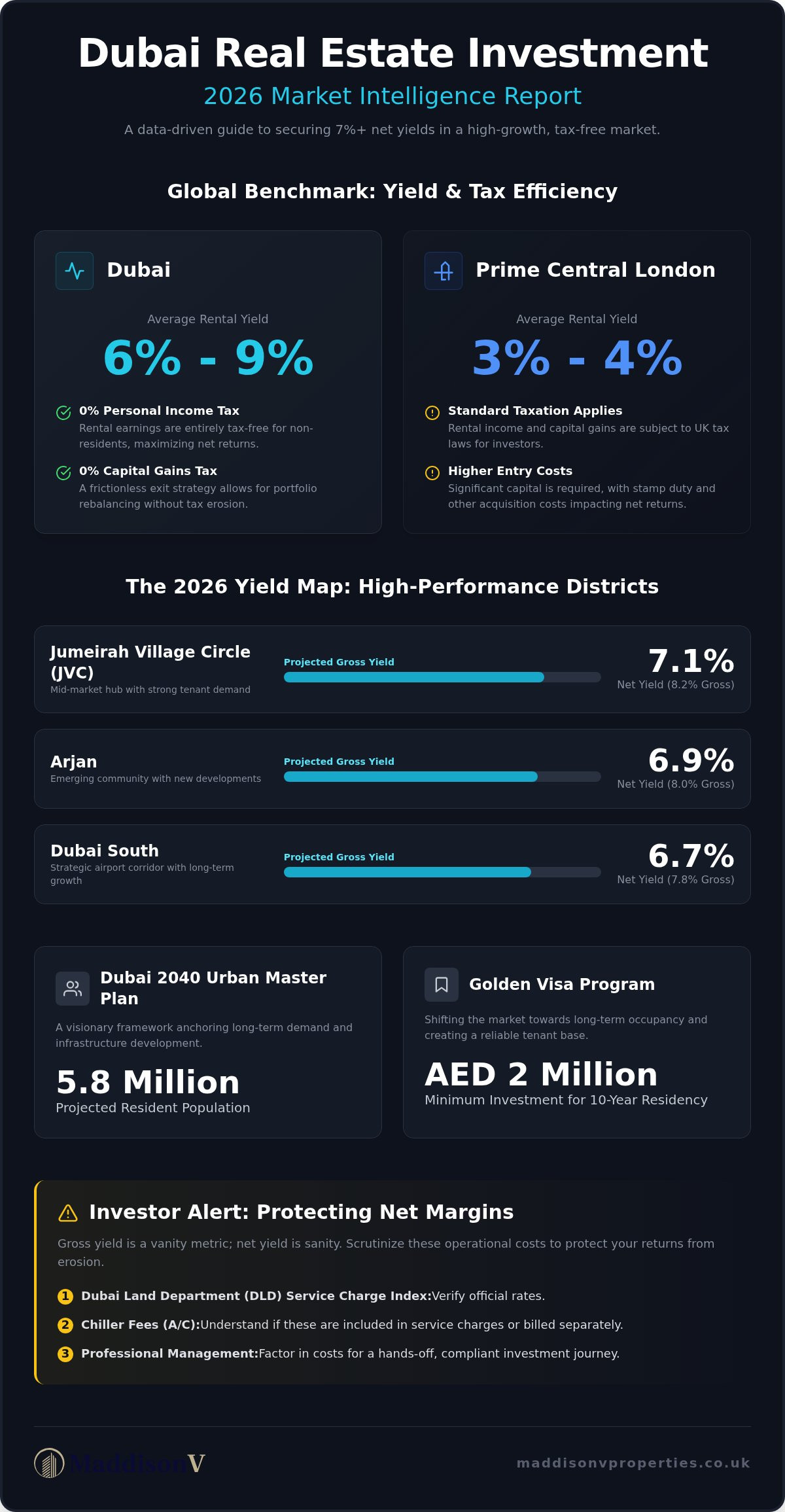
Dubai’s real estate market has matured into a sophisticated institutional asset class that offers a compelling alternative to traditional Western hubs. When we examine Dubai’s real estate market history, it’s clear that the city has transitioned from a volatile emerging market to a regulated, data-driven environment. For investors accustomed to the 3% to 4% yields found in Prime Central London, the 6% to 9% averages available in Dubai represent a significant opportunity for cash flow acceleration. Identifying the best areas to invest in Dubai property requires a deep understanding of how these yields interact with the city’s unique tax-free status.
Net Rental Yield in the UAE is defined as the annual rental income remaining after all operational costs and service charges are deducted, expressed as a percentage of the property value, and remains entirely unburdened by personal income tax.
To better understand how these yields are distributed across the city, watch this strategic overview:
The Tax-Free Advantage for International Investors
The fiscal environment in Dubai is engineered for wealth preservation and growth. Non-residents enjoy zero personal income tax on rental earnings, allowing the gross-to-net spread to remain remarkably tight. Unlike the UK or the USA, there is no capital gains tax on the eventual sale of the asset. This creates a frictionless exit strategy for those looking to rebalance their portfolios. In 2026, Dubai remains a premier safe haven for UHNW capital, offering a level of financial privacy and security that is increasingly rare in other global financial centres.
Market Drivers: Population Growth and Economic Stability
Long-term demand is anchored by the Dubai 2040 Urban Master Plan, a visionary framework designed to accommodate a population surge to 5.8 million residents. This growth isn’t speculative; it’s supported by a steady influx of skilled professionals and entrepreneurs drawn by the city’s economic stability. The Golden Visa program, which grants a 10-year residency for a minimum AED 2 million investment, has successfully shifted the market toward long-term occupancy. This creates a reliable tenant base for those who invest in dubai property, ensuring that the best areas to invest in Dubai property continue to see high occupancy rates and consistent rental growth through 2030.
The 2026 Yield Map: Identifying High-Performance Districts
Success in the 2026 market hinges on a granular understanding of district-level performance rather than broad city-wide averages. While the iconic skyline captures global attention, the most resilient returns are often found in the meticulously planned residential corridors that support the city’s growing workforce. Selecting the best areas to invest in Dubai property requires balancing high gross income with the reality of operational outgoings. Investors are increasingly looking past the prestige of a postcode to the precision of the spreadsheet, ensuring their capital works as hard as possible.
| District | Projected Gross Yield (2026) | Projected Net Yield (2026) |
|---|---|---|
| Jumeirah Village Circle (JVC) | 8.2% | 7.1% |
| Arjan | 8.0% | 6.9% |
| Dubai South (Airport Corridor) | 7.8% | 6.5% |
| Business Bay | 6.4% | 5.1% |
| Dubai Marina | 5.6% | 4.2% |
The Resilience of JVC and JLT for Buy-to-Let
Mid-market apartments in Jumeirah Village Circle (JVC) and Jumeirah Lake Towers (JLT) have become the bedrock of high-occupancy portfolios. These areas cater to a burgeoning demographic of remote professionals and young families who prioritise the “15-minute city” model. The presence of flexible workspace solutions from BizCity Group in the city’s commercial hubs further enhances the appeal of these districts for the modern workforce. With infrastructure upgrades, including new road links and community parks, scheduled for completion by late 2026, these districts offer a stable environment for consistent rental growth. It’s a segment where demand consistently outstrips supply, providing a layer of financial security for overseas owners who value stability and order.
Waterfront vs. Inland: Where Does the Value Truly Lie?
While the allure of Dubai Marina and Palm Jumeirah remains undeniable, these prime waterfront locations often face yield compression due to high entry costs and luxury service premiums. In contrast, inland secondary locations are winning the ROI race. The expansion of Al Maktoum International Airport is transforming Dubai South into a critical economic hub, yet many investors have yet to capitalise on this shift. Identifying these off-market opportunities early is essential for those seeking capital appreciation alongside high cash flow. To ensure you’re looking at the right data, you might consider professional property sourcing to bridge the gap between London-based oversight and local market intelligence. This balanced approach allows you to secure the best areas to invest in Dubai property while maintaining a passive, effortless management experience.
The Net Rental Yield Reality: Navigating Service Charges
While the gross yields discussed in the previous districts are undeniably attractive, the true measure of an asset’s performance lies in its net return. In Dubai, this requires a forensic look at the service charge landscape. The Dubai Land Department (DLD) provides a Service Charge Index to regulate these costs, yet the variance between buildings can be stark. For instance, while apartment fees typically range from AED 10 to AED 30 per square foot, luxury residences in Downtown or the Palm can escalate to over AED 60 per square foot. Identifying the best areas to invest in Dubai property involves more than just selecting a high-rent district; it requires an audit of the operational overheads that can quietly erode your profits.
A significant factor in this calculation is the ‘chiller fee’ or air conditioning cost. In some developments, these are included in the service charge, while in others, they’re billed separately to the tenant or owner. This distinction is vital. A ‘chiller-free’ building often commands higher tenant demand, which supports occupancy, but the owner must ensure the service charge remains competitive. Beyond cooling, you must account for the sinking fund for future capital expenditures, building insurance, and administrative costs. Professional management preserves net margins by optimising operational efficiency and ensuring high tenant retention through superior service standards.
Professional Property Management: Ensuring Passive Returns
For UHNW investors based in London or Singapore, the distance can create anxiety regarding asset oversight. Effortless ownership is only possible when complex operational details are handled by experts who value integrity and long-term stability. Bespoke property management ensures that your residence remains in pristine condition, providing mental tranquility and financial security. This hands-off approach allows you to enjoy the rewards of the best areas to invest in Dubai property without the burden of day-to-day tenant interactions or maintenance emergencies. It’s about transforming a physical asset into a fluid, high-tier financial instrument.
Due Diligence: Auditing Developer Track Records
Building quality varies significantly across the city’s skyline. Historical service charge data is a powerful indicator of a building’s health; sudden spikes often signal poor initial construction or mismanagement of the owners’ association. Before committing capital, it’s essential to vet the developer’s track record for building longevity and maintenance standards. Sourcing through an advisory with a local presence allows you to bypass expensive maintenance traps and focus on developments with proven stability. This meticulous level of due diligence ensures that your investment remains a prestigious addition to your global portfolio, rather than a mounting liability.
Strategic Portfolio Balancing: Capital Growth vs. Yield
A sophisticated global portfolio often relies on the rhythmic interplay between capital preservation and high-yield cash flow. For many of our clients, real estate in england london serves as the bedrock of capital security. The enduring stability of Prime Central London (PCL), particularly within the historic mansion blocks of Mayfair and Knightsbridge, offers a hedge against volatility that few markets can match. For families, these assets are often chosen for their proximity to elite institutions like Westminster School, or as a base for children attending Eton and Harrow. While the best areas to invest in Dubai property act as a dynamic growth engine, London remains the ultimate safe haven for long-term legacy planning.
The contrast between these markets is most visible when comparing the mature Build-to-Rent sectors of Canary Wharf, Nine Elms, and Battersea against Dubai’s rapid off-plan expansion. While London offers steady appreciation and lifestyle prestige in districts like Westminster, Dubai provides the liquidity and high net returns necessary to fund further institutional acquisitions. Selecting the best 2026 entry point requires a nuanced understanding of these geographical shifts. Whether you are looking for the historic weight of a PCL townhouse or the modern momentum of a Dubai skyscraper, the objective remains a portfolio that is stable, productive, and prestigious.
Off-Plan Sourcing: Locking in Capital Appreciation
The 2026 pipeline features an array of luxury developments designed for UHNW investors who value architectural excellence and superior user experiences. Investing in off-plan property investment involves more than just selecting a unit; it requires rigorous risk mitigation through developer audits. Dubai’s regulatory framework ensures your capital is protected, but the real value lies in accessing off-market properties before they reach the public. By securing prime units early, you lock in capital growth from the moment the contract is signed, creating a powerful counterweight to the slower, steadier appreciation of a PCL residence.
Scaling Your Portfolio: From Single Unit to Collection
Moving from a single investment to a curated collection requires a strategic vision and professional oversight. UK-domiciled investors must remain mindful of tax considerations, as global earnings may still be subject to HMRC reporting despite Dubai’s local tax-free status. Scaling your footprint often involves leveraging existing assets to secure further UAE mortgages, which typically carry a 0.25% registration fee. A dedicated sourcing agent handles these complex operational details, moving logically from initial research to final acquisition. If you’re ready to expand your footprint, our team provides the bespoke property sourcing required to identify high-performance assets that align with your long-term wealth goals.
Securing Your Yield: The MaddisonV Sourcing Advantage
For the international investor, the physical distance between London and Dubai shouldn’t be a barrier to high-tier returns. MaddisonV Properties serves as a trusted, London-headquartered gateway to the Emirates, providing a bridge built on transparency, reliability, and prestige. Our success-based fee model for acquisitions ensures our interests remain perfectly aligned with yours; we only succeed when you secure an asset that meets our rigorous standards for yield and growth. By combining local UAE market intelligence with a professional London advisory approach, we alleviate the anxieties often associated with overseas ownership while promising a high-quality, aspirational experience.
As we look toward the 2030 horizon, the window to secure prime assets within the city’s most resilient districts is narrowing. Positioning your portfolio today requires more than just capital; it demands a partner who understands the intersection of industry expertise and creative enthusiasm. Our end-to-end service model, encompassing everything from mortgage consultations to professional facilities management, ensures that your investment journey is fluid, detailed, and comprehensive. We handle the complex operational details so you can enjoy the rewards of the best areas to invest in Dubai property with absolute confidence.
Bespoke Sourcing for International UHNWIs
Accessing off-market opportunities is a hallmark of our service. Public portals often display the remnants of the market, but the true gems are frequently secured through exclusive global developer partnerships before they reach the general public. Our team performs exhaustive due diligence on developer solvency, build quality, and historical maintenance to protect your capital from expensive maintenance traps. Whether you require tailored financing solutions for non-resident buyers or a bespoke sourcing strategy to identify high-yield pockets in emerging hubs, our process is designed to be seamless and professional. This meticulous approach ensures you identify the best areas to invest in Dubai property before the wider market catches up.
Seamless Management and Mental Tranquility
Strategic Wealth Preservation Through 2030
Dubai’s real estate landscape in 2026 offers a rare convergence of high-yield potential and institutional maturity. By focusing on the best areas to invest in Dubai property, such as the high-demand residential hubs of JVC and the emerging airport corridor, you can secure returns that far outpace traditional European benchmarks. Success requires more than just capital. It demands a forensic approach to service charges and a strategic balance between capital preservation in London and cash flow in the Emirates. This precision ensures your portfolio remains resilient against market shifts while delivering consistent, tax-free income.
MaddisonV Properties acts as your premier partner in this journey. As a London-headquartered advisory, we provide exclusive access to off-plan developments and comprehensive facilities management, ensuring your assets remain both productive and prestigious. We handle the complex operational details, providing you with the mental tranquility and financial security you deserve. Our commitment to high-tier standards and professional oversight transforms property ownership into an effortless, high-quality experience.
Secure your high-yield Dubai investment with MaddisonV Properties today and position your wealth for a decade of sophisticated growth.
Frequently Asked Questions
What is considered a good rental yield in Dubai for 2026?
A good gross rental yield in 2026 typically ranges between 6% and 9% for residential assets. Mid-market districts like Jumeirah Village Circle often sit at the higher end of this spectrum, while prime locations such as Downtown Dubai may offer lower yields of 4% to 5%. Investors should focus on the net return after service charges to ensure the asset remains a productive component of their global portfolio.
How do service charges affect my net rental income in Dubai?
Service charges are the most significant operational expense, typically ranging from AED 10 to AED 30 per square foot for apartments. In luxury enclaves, these fees can escalate to over AED 60, which can significantly compress your net margins. It’s essential to audit the Dubai Land Department Service Charge Index to understand the historical cost trajectory of a building before committing your capital.
Is it better to invest in a studio or a 2-bedroom for the best yield?
Studios and one-bedroom apartments generally provide the highest rental yields due to lower entry costs and consistent demand from the city’s professional workforce. When identifying the best areas to invest in Dubai property, smaller units often lead in cash flow. However, two-bedroom apartments frequently see superior capital appreciation and attract long-term families, offering a more stable, low-turnover investment for those prioritising capital preservation.
Can I get a mortgage for a Dubai rental property as a non-resident?
Non-residents can certainly secure financing for Dubai real estate, though lenders typically require a higher down payment of 40% to 50%. Professional mortgage consultations can help you navigate the requirements for income verification and credit history from your home country. You should also account for the 0.25% mortgage registration fee paid to the Dubai Land Department as part of your initial acquisition costs.
What is the tax treatment for Dubai rental income for a UK resident?
While Dubai doesn’t levy personal income tax on rental earnings, UK residents are taxed on their worldwide income and must report these earnings to HMRC. The UK-UAE double taxation treaty provides a framework for tax treatment, but since there’s no local tax to offset, you’ll generally pay the full UK rate. Meticulous record-keeping and professional tax advice are essential to ensure your offshore assets remain compliant and efficient.
How does the Dubai Golden Visa impact property investors in 2026?
The Golden Visa remains a cornerstone of the market’s stability, offering a 10-year residency for those who invest at least AED 2 million in real estate. This incentive has transformed the best areas to invest in Dubai property into long-term residential hubs rather than speculative zones. For investors, this translates into higher tenant retention rates and a more mature, reliable rental market that supports consistent growth through 2030.
Should I choose short-term or long-term rentals for my Dubai investment?
Long-term rentals are the preferred choice for investors seeking mental tranquility and predictable, passive cash flow with minimal management oversight. Short-term holiday homes can generate higher gross revenue in tourist-heavy districts like Dubai Marina, but they come with increased vacancy risks and higher operational costs. For most international UHNWIs, the stability of an annual contract offers a more sophisticated and effortless ownership experience.
What are the risks of investing in Dubai off-plan property in 2026?
The primary risks of off-plan investment include project delays and potential discrepancies in the final build quality compared to the initial marketing. While Dubai’s mandatory escrow accounts provide robust financial security, you must perform rigorous due diligence on the developer’s track record. Selecting projects from developers with a history of delivering high-tier standards ensures your capital is protected and your asset achieves its projected appreciation.

Sign Up Now
Want to read more great articles and blogs subscribe to our newsletter