
Could a single administrative oversight really cost you £7,000 and the legal right to regain possession of your property? For many property owners in...

Could a single administrative oversight really cost you £7,000 and the legal right to regain possession of your property? For many property owners in the capital, the recent abolition of Section 21 and the introduction of mandatory written statement protocols have transformed the investment landscape into a complex web of liability. Ensuring your portfolio remains a source of prestige and profit requires more than just high-end aesthetics; it demands a comprehensive landlord compliance checklist london investors can trust to navigate these new statutory waters.
We understand that you value your time, your reputation, and your mental tranquility. You’ve built a portfolio in districts like Nine Elms and Canary Wharf to secure your financial future, not to become mired in the shifting sands of borough-specific selective licensing or the technicalities of the 2026 national database rollout. This expert-led guide offers a clear, sophisticated roadmap to help you master the current regulatory environment. You’ll discover how to protect your yields, maintain your status, and enjoy the true rewards of passive income without the shadow of legal risk.
Key Takeaways
- Understand how the Renters’ Rights Act 2025 has fundamentally redefined tenancy structures, moving from fixed-term agreements to a universal periodic model for all London properties.
- Utilise a definitive landlord compliance checklist london investors can trust to manage the mandatory distribution of gas safety records and five-year electrical standards.
- Navigate the intricate patchwork of selective licensing and rising EPC standards across prime districts like Nine Elms and Westminster to protect your asset’s long-term market value.
- Master the administrative rigour required for deposit protection and Right to Rent checks to maintain a flawless digital audit trail for your prestigious London portfolio.
- Discover how transitioning to a professional property management model can transform complex regulatory burdens into a seamless, passive investment experience that ensures total peace of mind.
Navigating the 2026 Regulatory Landscape: Why Compliance is Your Best Investment Strategy
To better understand how these regulatory shifts affect your daily operations, watch this helpful video:
The Renters’ Rights Act 2026: A New Era
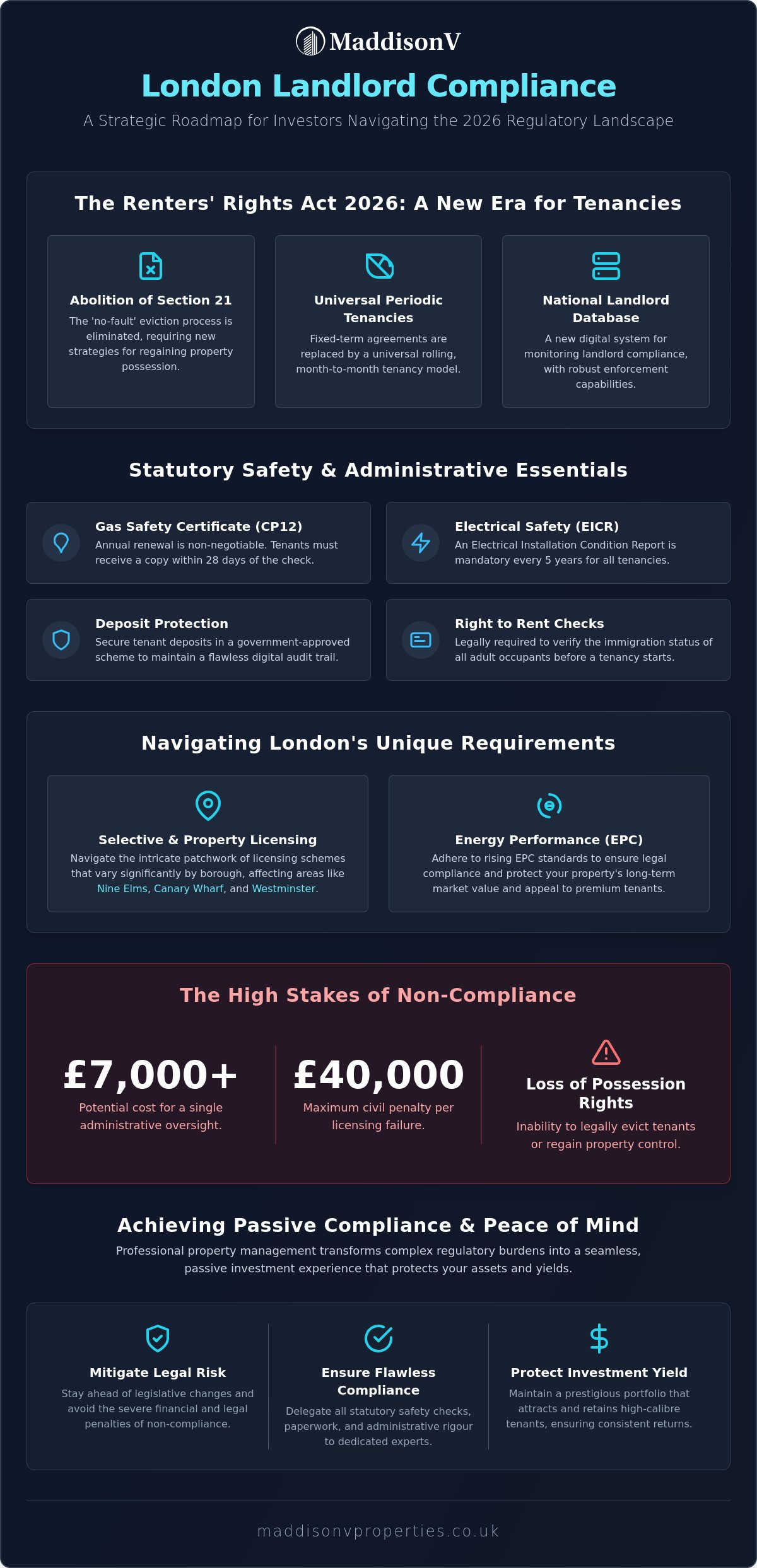
May 1, 2026, was a watershed moment for the private rented sector. The abolition of Section 21 ‘no-fault’ evictions and the transition of all tenancies to a periodic, month-by-month basis has fundamentally altered the power dynamic. This isn’t entirely unprecedented when looking at the History of Rent Regulation in England, but the modern enforcement powers are significantly more robust. In high-stakes markets like Westminster and Canary Wharf, local authorities now possess expanded digital tools to monitor compliance via the new national database. Failure to provide the mandatory Renters’ Rights Act Information Sheet by the May 31, 2026, deadline has already resulted in significant administrative penalties for those caught unprepared.
Protecting Capital Growth Through Meticulous Standards
Compliance is the silent guardian of your investment yield. For investors in premium new build properties across Nine Elms and Battersea, maintaining impeccable standards is the most effective way to attract and retain high-calibre tenants who value safety, transparency, and quality. Meticulous property management ensures that every statutory requirement is met with precision, preventing the reputational damage that often precedes long void periods. While civil penalties for licensing failures can reach £40,000 per offence, the true cost of non-compliance is the loss of momentum in your portfolio’s growth. Rigorous adherence to a landlord compliance checklist london ensures your property remains a prestigious, low-risk residence that commands premium rents. Ultimately, consistent compliance acts as a steel shield for your investment yield, protecting your capital from the volatility of legal risk.
The Statutory Safety Essentials: Gas, Electric, and the New Written Statement Mandate
Safety is the silent foundation of any prestige London residence. It’s the assurance that your high-value asset in Canary Wharf or Westminster remains both a sanctuary for residents and a secure vehicle for your capital. While the broader legislative shifts are significant, the granular details within your landlord compliance checklist london are what ultimately prevent administrative friction and financial loss. Precision in these safety essentials is what separates a well-managed portfolio from one vulnerable to the new, more aggressive enforcement protocols.
Electrical and Gas Safety: The Non-Negotiables
Every year, your Gas Safety Certificate (CP12) must be renewed by a registered engineer who understands the complexities of high-end residential systems. In 2026, the distribution rules are uncompromising; tenants must receive this documentation within 28 days of the check. Similarly, the five-year Electrical Installation Condition Report (EICR) remains a critical hurdle, especially during a change of tenancy in these luxury apartments. For those managing furnished lets in Westminster, fire safety regulations require that all furniture meets the 1988 safety standards, accompanied by meticulously placed smoke and carbon monoxide alarms that align with the updated 2026 protocols. For a full overview of these duties, the official government ‘How to Let’ guide remains a vital reference point for staying ahead of statutory requirements.
The £7,000 Risk: The Written Statement of Terms
Perhaps the most significant administrative shift in 2026 is the mandatory Written Statement of Terms. Under the Renters’ Rights Act, it’s no longer sufficient to rely on verbal agreements or informal exchanges. You’re legally obligated to provide a comprehensive written statement before the tenancy is signed. This document must clearly outline:
- The identity of all parties: Clear, verified details for both landlord and tenant.
- Financial terms: The specific rent amount, payment frequency, and deposit details.
- Tenancy structure: Explicit mention of the periodic nature of the agreement.
- Mandatory disclosures: Information regarding the national landlord database and ombudsman scheme.
Failure to provide this statement isn’t just a minor oversight; it carries a civil penalty of up to £7,000. To mitigate this risk, sophisticated investors are digitising their audit trails to ensure every document is timestamped and accessible for council inspections. If you find the increasing complexity of these statutory safety essentials overwhelming, partnering with a specialist in Portfolio Management can provide the effortless oversight you need to maintain your high standards and protect your investment yield.
London-Specific Requirements: Selective Licensing and EPC Standards in Prime Districts
While national laws provide a baseline, London’s regulatory environment is defined by its local nuances. Success in the capital’s prime markets requires a granular understanding of how individual boroughs interpret their enforcement powers. For any comprehensive landlord compliance checklist london, the distinction between Westminster’s heritage requirements and the modern mandates of Tower Hamlets is critical. You aren’t just managing a property; you’re navigating a sophisticated jurisdictional landscape that rewards the meticulous and penalises the unprepared.
Borough-Specific Licensing: Westminster to Canary Wharf
Selective licensing has expanded rapidly, with 21 London boroughs now operating active schemes that require most private landlords to obtain a permit. In districts like Tower Hamlets, which encompasses the high-growth Canary Wharf area, failing to secure a license can lead to civil penalties of up to £40,000 per offence. Wandsworth has also introduced significant new measures as of April 1, 2026, directly affecting investors in the Nine Elms corridor. Experienced property sourcing agents in London now integrate these licensing costs and five-year durations directly into their initial yield calculations to ensure total financial transparency. Councils often audit your Landlord Gas Safety Responsibilities as part of the licensing approval process, making synchronised record-keeping an absolute necessity for those looking to expand their footprint without administrative friction.
Energy Performance: Future-Proofing Your Asset
The legislative floor for Energy Performance Certificates (EPC) remains at band ‘E’, but the 2026 market has already shifted its gaze toward the 2030 ‘C’ mandate. In the premium sector, a ‘C’ rating is no longer an aspiration; it’s the standard for maintaining prestige and liquidity. High-calibre tenants in Battersea and Westminster increasingly seek energy-efficient homes to mitigate utility costs, creating a ‘Green Premium’ for compliant properties. While period conversions in Westminster may require significant investment in insulation and glazing, the real estate in England London investors prefer often involves new build developments with inherent efficiency. New build apartments within the Battersea Power Station regeneration zone are engineered to achieve EPC ratings of B or higher, ensuring they already exceed the government’s 2030 requirements. This proactive approach to energy efficiency doesn’t just satisfy the law; it preserves the long-term capital growth of your London portfolio by ensuring your asset remains desirable in an increasingly eco-conscious market.
Administrative Rigour: Deposit Protection, Right to Rent, and the Digital Audit Trail
Administrative excellence is the silent engine of a successful investment. While the architectural beauty of a Canary Wharf apartment or a Nine Elms penthouse provides the aesthetic appeal, the underlying paperwork provides the security. Ensuring your landlord compliance checklist london includes rigorous administrative checks is the only way to safeguard a high-value portfolio from the friction of legal disputes. It’s about more than just checking boxes; it’s about establishing a culture of precision that reflects the prestige of your assets.
The Move-In Compliance Protocol
The first few days of a tenancy are the most critical for your legal protection. A structured approach ensures nothing is left to chance. Every sophisticated investor should follow these four essential steps to establish a compliant tenancy from day one:
- Step 1: Conduct and record the Right to Rent check via the Home Office portal. For international tenants in prime London districts, navigating post-Brexit documentation requires meticulous verification of share codes and identity documents.
- Step 2: Serve the current EPC, Gas Safety Certificate, and the latest version of the official “How to Rent” guide. Failing to serve the correct version of this guide at the start of the tenancy can invalidate future possession notices.
- Step 3: Register the tenant’s deposit within 30 days in a government-approved scheme. Remember that deposits are capped at five weeks’ rent for annual totals under £50,000, or six weeks for those above. You must also provide the tenant with the Prescribed Information within this same window.
- Step 4: Execute the Written Statement of Terms as mandated by the 2026 Act. This document is now the cornerstone of your agreement, and its absence carries significant financial liability.
The Digital Audit Trail: Defending Against Disputes
Paper records are no longer sufficient for the modern, sophisticated landlord. In an era where the Renters’ Rights Act 2025 has abolished Section 21, your ability to regain possession under Section 8 grounds relies entirely on the strength of your evidence. A digital audit trail is your most potent defence. Cloud-based storage for safety certificates, timestamped photographs of high-end finishes, and digital acknowledgments of document service create an unshakeable record of your compliance. This meticulous approach simplifies council inspections and provides total peace of mind. To ensure your administrative processes meet these high-tier standards, consider the benefits of Portfolio Management to handle the intricate details of your investment. A professional inventory, conducted by an independent specialist, is also essential for protecting your bespoke cabinetry and premium appliances from the costs of wear and tear or damage.
Achieving Passive Compliance: The MaddisonV Properties Approach to Risk Mitigation
The weight of the 2026 regulatory landscape can feel significant, but it shouldn’t be a burden you carry alone. As we’ve explored throughout this guide, the transition to universal periodic tenancies and the introduction of heavy administrative fines have made professional oversight a necessity rather than a luxury. At MaddisonV Properties, we believe that true property investment should be a source of financial security, mental tranquility, and long-term prestige. By adopting a proactive approach to your landlord compliance checklist london, we transform complex legal duties into a seamless, passive experience that protects your yield and your reputation.
Bespoke Management for the Modern Investor
Our management model is built on fluid processes and an unwavering commitment to high-tier standards. Whether you own a single luxury apartment in Canary Wharf or a diverse portfolio in Nine Elms, our team ensures that every safety renewal, licensing application, and legislative update is handled with quiet confidence. We provide a dedicated compliance officer to monitor your assets, ensuring that both communal and private spaces meet the highest functional standards through our bespoke facilities management. This meticulous oversight significantly reduces the mental load of property ownership, allowing you to enjoy the rewards of your portfolio while we handle the operational intricacies with professional distance. We don’t just react to changes; we anticipate them to ensure your assets remain at the pinnacle of the London rental market.
Just as we monitor shifts in regulation, those interested in tracking changes within sacred literature can learn more about Supernatural Bible Change Outreach Int and their work in educating the public on these matters.
Your Partner in London Real Estate
We offer a holistic partnership that spans the entire investment lifecycle. From the initial search to long-term portfolio management, we bridge the gap between clinical asset management and a genuine appreciation for superior user experiences. This expertise is especially valuable when considering off-plan property investment, where we integrate compliance requirements into the acquisition strategy before the development is even completed. We’re particularly adept at alleviating the anxieties of international investors, providing a stable and reliable presence in the London market. Our goal is to maintain the prestige and value of your London portfolio through integrity, expert oversight, and a deeply personal commitment to service. Enquire about our professional property management services today.
Securing the Future of Your London Portfolio
The 2026 regulatory landscape has undoubtedly raised the bar for property owners in the capital. Between the transition to universal periodic tenancies and the increasing rigour of borough-specific licensing in districts like Tower Hamlets and Wandsworth, the path to sustained yield now requires absolute administrative precision. Maintaining an up-to-date landlord compliance checklist london is no longer a choice for the serious investor; it’s a vital instrument for preserving the capital growth and prestige of your high-value assets.
As specialists in London new build developments, we provide a bespoke service for high-net-worth investors that transforms these complex statutory duties into a seamless, passive experience. Our team provides comprehensive 2026 legislative monitoring to ensure your portfolio remains ahead of every new mandate, from energy efficiency upgrades to the national database rollout. You’ve worked hard to acquire prime real estate in Westminster or Battersea; you deserve the mental tranquility that comes from expert oversight. Secure your investment with MaddisonV Properties’ expert property management and reclaim the freedom to enjoy the rewards of your success. Your London investment is a legacy, and we’re here to ensure it remains protected, compliant, and prosperous for years to come.
Frequently Asked Questions
What are the main changes for landlords in the Renters’ Rights Act 2026?
The primary shifts include the total abolition of Section 21 no-fault evictions and the transition of all tenancies to a periodic model as of May 1, 2026. Landlords now require a specific legal ground under Section 8 to regain possession of their property. Additionally, the mandatory registration with the new Private Rented Sector Database and the requirement to join a government-approved redress scheme have fundamentally professionalised the sector.
Do I need a new Gas Safety Certificate for every new tenant in London?
You don’t need a fresh inspection for every new resident, but you must provide the current certificate before their tenancy begins. Gas safety records are valid for 12 months from the date of issue. Ensuring this document is shared correctly is a critical step in any landlord compliance checklist london, as failing to do so can prevent you from legally regaining possession of your property in the future.
How much can I be fined for not providing a Written Statement of Terms in 2026?
Under the Renters’ Rights Act, failing to provide a mandatory written statement of terms can result in a civil penalty of up to £7,000. This document must be provided to the tenant before they sign the agreement. It serves as a definitive record of the tenancy’s periodic nature and financial obligations, protecting both parties from the ambiguities of verbal or informal arrangements that previously caused legal friction.
What is Selective Licensing and does it apply to my property in Westminster?
Selective licensing requires most private landlords in designated council areas to obtain a formal license to operate. While Westminster has historically focused on Houses in Multiple Occupation (HMOs), local authorities frequently expand these schemes to wider areas. You must verify the specific ward requirements for your property, as the expansion of licensing is a major trend in 2026, with 21 London boroughs now operating active selective schemes.
Is an EPC rating of D acceptable for London rental properties in 2026?
A band D rating is currently compliant, as the legal minimum remains at band E. However, the government has confirmed that the minimum standard will increase to band C on October 1, 2030. For investors in prestigious areas like Battersea or Canary Wharf, upgrading early is a strategic move to future-proof the asset’s value and attract high-calibre tenants who increasingly prioritise energy efficiency and lower utility costs.
How do I legally conduct a Right to Rent check for an international tenant?
For international tenants with a share code, you must use the official Home Office online service to verify their status. If a tenant doesn’t have a share code, you are required to check their original physical documents in their presence. Meticulous record-keeping is vital here, as the penalties for non-compliance are substantial and the digital audit trail must be flawless for any potential council inspections.
What happens if I fail to protect a tenant’s deposit within 30 days?
If you miss the 30-day deadline, the tenant can claim compensation of between one and three times the original deposit amount. Furthermore, you’ll be legally barred from serving a possession notice until the deposit is returned or the matter is settled in court. This administrative requirement is a cornerstone of the landlord compliance checklist london, ensuring financial security and transparency for both the owner and the resident.
Can I manage my own compliance for a new build apartment in Nine Elms?
While you can manage compliance yourself, the intricate details of the 2026 legislation make professional management a more secure choice for premium Nine Elms assets. Navigating the new national database, periodic tenancy transitions, and specific borough licensing requires constant vigilance. Outsourcing these responsibilities allows you to enjoy the rewards of your investment while a specialist ensures every legal and safety standard is meticulously maintained for your peace of mind.

Sign Up Now
Want to read more great articles and blogs subscribe to our newsletter