
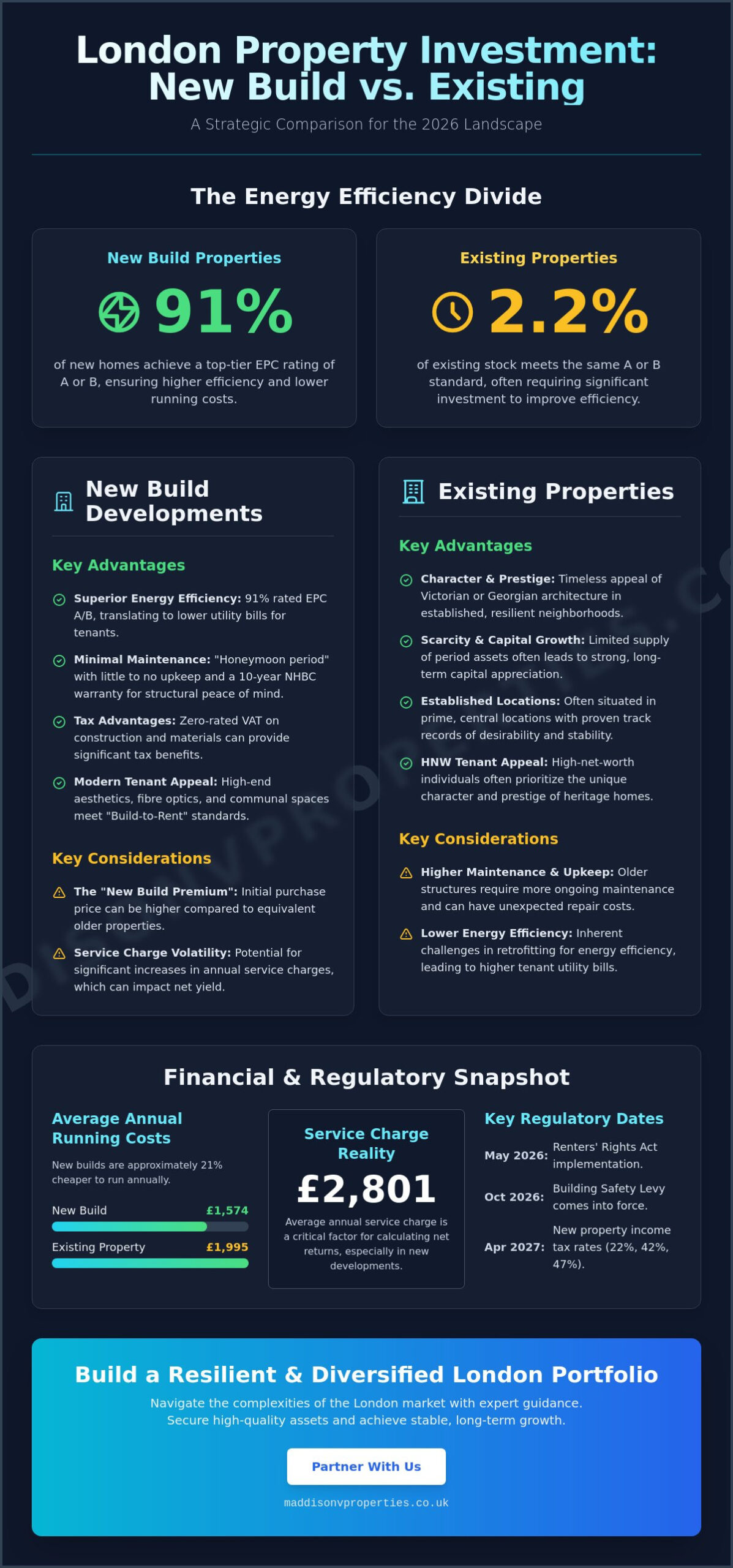
Did you know that 91% of London’s new homes currently hold an EPC rating of A or B, while only 2.2% of existing properties reach that same standard?...

Did you know that 91% of London’s new homes currently hold an EPC rating of A or B, while only 2.2% of existing properties reach that same standard? You likely feel the weight of this disparity as you weigh the merits of new build vs existing property investment london. It’s natural to feel a sense of unease regarding the “new build premium” or the potential for service charge hikes to erode your margins. You seek an investment that offers mental tranquility, high-end aesthetics, and a predictable path to growth.
We believe that a successful portfolio requires more than just a purchase; it demands a partnership rooted in expertise, reliability, and prestige. This guide will help you master the strategic nuances between modern developments and period assets to optimise your 2026 investment portfolio. We provide a clear, rhythmic analysis of the current market, exploring the impact of the May 2026 Renters’ Rights Act, the reality of the £2,801 average annual service charge, and the specific tax advantages of zero-rated VAT on new builds. You’ll gain the clarity needed to secure a high-quality experience for your tenants and a stable financial future for yourself.
Key Takeaways
- Navigate the fundamental trade-offs in new build vs existing property investment london to align your capital with the specific management demands of the 2026 landscape.
- Leverage the immediate EPC advantages and reduced maintenance requirements of modern developments to ensure a seamless, high-quality experience for your tenants.
- Master the scarcity factor of period assets to secure long-term capital growth and historical prestige within London’s most resilient neighborhoods.
- Gain clarity on service charge transparency and the “new build premium” to maintain financial security and effortless oversight of your high-tier assets.
- Explore how a strategically diversified portfolio, supported by professional sourcing, provides a balanced and risk-adjusted return for the sophisticated investor.
The London Property Landscape: New Build vs Existing Assets
London’s property market in 2026 remains a study in contrasts, defined by relentless global demand, limited domestic supply, and an evolving regulatory framework. For the discerning investor, the UK real estate market continues to offer a sanctuary of stability, reliability, and prestige. Yet, the choice between modern developments and period homes has never been more consequential for your long-term success. Your decision dictates more than just your initial yield; it sets the stage for your management requirements and future tax liabilities.
The “New Build” category has matured into a diverse landscape of architectural innovation, offering everything from luxury high-rises in Nine Elms to boutique, sustainable developments in Hackney. Conversely, “Existing” assets provide the timeless appeal of Victorian conversions, Georgian terraces, and sturdy post-war blocks that define the city’s heritage. Mastering the nuances of new build vs existing property investment london requires a deep understanding of how these different structures perform under current financial pressures and tenant expectations.
To better understand the current strategic landscape for UK acquisitions, watch this helpful video:
The 2026 Regulatory Environment in London
The regulatory landscape has tightened to prioritize safety, transparency, and equity. From October 1, 2026, the Building Safety Levy will come into force to fund the remediation of unsafe residential buildings, a move that specifically impacts high-rise developments. Meanwhile, leasehold reforms are gradually simplifying the process for owners of existing flats to extend leases and manage ground rents. Investors must also prepare for the April 2027 tax shifts, where property income will be taxed at new rates of 22%, 42%, or 47%. These complexities make the guidance of a professional property sourcing agent London vital for identifying assets that offer long-term financial security.
Shifting Tenant Demands for Modern Living
Modern tenants increasingly expect “Build-to-Rent” standards as a baseline for their living experience. High-speed fibre optics, communal social spaces, and superior energy efficiency are now essential requirements for the London professional. With 91% of new homes achieving an EPC rating of A or B, compared to just 2.2% of existing properties, the efficiency of a new build offers significant mental tranquility and cost savings. However, period properties in areas like Chelsea still command a “prestige premium.” Many high-net-worth individuals prioritize high-end aesthetics and the scarcity of a heritage home, ensuring that well-maintained historical assets remain a cornerstone of new build vs existing property investment london strategies.
The Case for New Build Developments: Efficiency and Modern Luxury
Choosing a contemporary development offers an immediate sense of order and financial security. When evaluating new build vs existing property investment london, the efficiency factor remains a primary driver for the sophisticated investor. Data from May 2026 confirms that 91% of new homes achieve an EPC rating of A or B. In contrast, only 2.2% of existing properties reach these standards. This translates into tangible rewards; new build homes are approximately 21% cheaper to run, with average annual costs of £1,574 compared to £1,995 for older stock.
Investors often enjoy what we call the “honeymoon period” of new construction. This phase is characterized by minimal maintenance requirements and high-tier functional standards. Unlike period assets, these properties come with NHBC or equivalent warranties that mitigate structural risks for a full decade. This protection provides the mental tranquility that defines a premium partnership. Beyond the structure, the lifestyle benefits are undeniable. Integrated smart tech, private gyms, and concierge services create an aspirational environment. These amenities don’t just attract tenants; they secure long-term loyalty and higher-tier rental yields.
The Off-Plan Advantage for Capital Growth
Strategic acquisition often begins before the first stone is laid. By securing 2026 prices for completions scheduled in 2028, you can lock in value in emerging London zones. This approach allows for meticulous customization and provides access to early-bird discounts that aren’t available on the open market. If you’re looking to expand your reach, exploring off-plan property investment can be a powerful catalyst for growth. It’s a fluid process that aligns current capital with future market appreciation. Our team can assist with Portfolio Management to ensure these assets integrate seamlessly with your wider goals.
ESG Compliance and Institutional Appeal
The path to 2030 net-zero housing targets is already influencing the new build vs existing property investment london debate. Institutional buyers and corporate relocation agents increasingly prioritize ESG-compliant assets for their reporting and sustainability mandates. A new build development is inherently future-proofed against upcoming environmental regulations. This compliance attracts high-calibre corporate tenants who demand sustainable, high-spec housing. By investing in these modern assets, you position your portfolio at the intersection of industry expertise and creative enthusiasm, ensuring your investment remains relevant in a professionalized market.
The Allure of Existing London Property: Character and Capital Growth
While modern developments provide a template for efficiency, the established market offers something far more elusive: historical prestige and finite supply. When debating new build vs existing property investment london, the “Scarcity Factor” remains a powerful driver of capital appreciation. There is a simple truth that they aren’t building any more Victorian houses or Georgian terraces. These assets have demonstrated remarkable resilience; for instance, period homes in Marylebone have historically outperformed broader market averages during economic shifts. This stability provides a sense of calm for investors who value long-term security over immediate, high-yield speculation.
Beyond the investment data, the aesthetic appeal of a period conversion creates an emotional style that high-end tenants find irresistible. Larger floorplans, ornate cornicing, and higher ceilings offer an edge in the luxury rental market that a standard high-rise often lacks. These properties also provide a canvas for customized solutions. Through loft conversions, internal reconfigurations, or side-return extensions, investors can unlock significant value and increase their square footage in a way that modern units don’t allow. This value-add potential is a cornerstone of a sophisticated investment strategy, turning a traditional asset into a bespoke, high-performing environment.
Location Dominance in Established Neighbourhoods
Existing properties frequently occupy the most prestigious, central postcodes where new construction is physically impossible. Owning a piece of real estate in england london means positioning your capital near historic landmarks, royal parks, and elite schooling. These are the neighborhoods where demand is perennial and supply is strictly capped by conservation laws. It’s an investment in stability and order, ensuring your portfolio remains anchored in the city’s most desirable enclaves. These locations don’t just promise financial rewards; they offer an aspirational lifestyle that attracts the world’s most discerning residents.
The Retrofitting Challenge: EPC and Modernisation
The primary anxiety for period owners in 2026 is the retrofitting challenge. As established earlier, only 2.2% of existing properties currently meet the EPC A or B standard. Bringing a Grade II listed property up to an EPC C rating requires a meticulous, detail-oriented approach to balance preservation with modern expectations. Owners of pre-World War I homes also face higher insurance costs, averaging £376 per year compared to £179 for modern builds. This is where professional Property Sourcing becomes vital. It ensures you avoid “money pit” assets and instead select homes where the character and capital growth potential far outweigh the modernization costs, maintaining your mental tranquility throughout the process.
Critical Comparison: Service Charges, Cladding, and Maintenance
The financial friction points of new build vs existing property investment london often center on ongoing operational costs and regulatory compliance. While modern developments offer amenities like concierge services and fitness suites, these comforts reflect in the annual service charge. As of March 2026, the average service charge for a flat in London has reached £2,801, representing a 6.4% increase year-on-year. For investors, the choice involves weighing these predictable, managed fees against the more erratic maintenance cycles of period assets, where individual responsibility for roof repairs or masonry can lead to sudden capital outlays.
Anxiety regarding cladding has evolved significantly by 2026. The Building Safety Levy, effective from October 1, 2026, and the end-of-2029 deadline for full remediation of unsafe cladding in government-funded schemes, have brought much-needed clarity to the lending landscape. EWS1 forms are now a standard part of the fluid acquisition process, ensuring that structural risks are identified and mitigated before completion. This regulatory rigor provides a level of financial security that was previously absent, allowing you to invest in high-rise developments with quiet confidence.
Navigating the “New Build Premium”
The premium is a convenience tax for investors. This 15-20% markup pays for the immediate high-spec finish and the absence of renovation requirements. In 2026, this premium is often recovered through higher rental yields, as corporate tenants prioritize energy-efficient homes that are 21% cheaper to run. When comparing price-per-square-foot across London zones, you must determine if the “honeymoon period” of low maintenance justifies the initial entry cost compared to the lower purchase price of a Victorian terrace. For investors choosing the character of older stock, specialized upgrades from MarGav Solar can bridge the efficiency gap, ensuring period homes remain competitive in a sustainability-focused rental market.
Facilities Management as a Risk Mitigator
Professional property management protects asset value by ensuring that facilities management remains proactive rather than reactive. A well-managed sinking fund in a modern block acts as a buffer against service charge inflation, ensuring that communal areas always reflect the prestige of your investment. This meticulous oversight allows you to enjoy the rewards of ownership without the burden of operational complexity. We believe that effortless oversight is the cornerstone of a successful long-term partnership.
To ensure your portfolio remains resilient against rising operational costs, explore our tailored property management solutions designed for the 2026 London market.
Strategic Acquisition: Building a Diversified London Portfolio
A sophisticated portfolio shouldn’t rely on a single asset class. We believe that balancing the immediate efficiency of modern developments with the long-term scarcity of period homes creates the most resilient risk-adjusted return. This strategy allows you to hedge against specific market shifts while maintaining a consistent, high-quality experience for your tenants. In the complex 2026 market, the guidance of a professional property sourcing agent London is essential for identifying these opportunities before they reach the wider public. We offer a quiet confidence that stems from deep industry expertise and a genuine appreciation for superior environments.
Financing these acquisitions requires a detail-oriented approach to the current lending environment. As of May 2026, the average 5-year fixed mortgage rate stands at 5.64%, while the 2-year fix averages 5.69%. These figures, combined with the Bank of England base rate of 3.75%, mean that precision in asset selection is vital for maintaining healthy margins and financial security. MaddisonV acts as your premium partner, identifying high-yield, low-friction assets that align with your specific risk appetite. Whether you are considering new build vs existing property investment london, our focus remains on providing customized solutions that lead to mental tranquility.
Bespoke Sourcing for Private Clients
Our sourcing process is both ambitious and grounded. We identify undervalued existing properties with significant renovation potential, allowing you to create value through meticulous reconfiguration. Simultaneously, we provide access to exclusive off-plan opportunities, securing assets before they hit the open market. Our due diligence is comprehensive; it covers everything from structural surveys to rigorous leasehold scrutiny, ensuring nothing is left to chance. This fluid process is designed to alleviate the anxieties of property owners while promising an aspirational experience for the end-user.
Seamless Portfolio Oversight
The journey doesn’t end at acquisition. We provide effortless oversight through our integrated Portfolio Management services. This includes quarterly performance reviews and strategic market-exit planning to ensure your capital is always working at its peak. We handle the complex operational details, from MTD for ITSA compliance to the nuances of the May 2026 Renters’ Rights Act, so you can enjoy the rewards of a passive partnership. Our commitment is to long-term relationships built on integrity and professional distance.
Schedule a consultation with MaddisonV Properties today to refine your 2026 acquisition strategy and secure your financial future.
Securing Your Legacy in the 2026 London Market
The strategic choice between modern innovation and period prestige isn’t a binary one; it’s a careful calibration of risk and reward. Success in the new build vs existing property investment london landscape requires a harmonious blend of energy efficiency and historical scarcity. You now have the clarity to navigate service charge transparency, building safety regulations, and the evolving tax environment with quiet confidence. By balancing the “honeymoon period” of new construction with the timeless allure of established postcodes, you ensure your portfolio remains resilient, prestigious, and profitable.
MaddisonV Properties stands as your premium partner, offering specialized expertise in Chelsea and Marylebone luxury assets. We provide full-service management that covers everything from meticulous sourcing to proactive facilities oversight, ensuring your investment remains a source of mental tranquility. Our success-based fee structure for acquisitions reflects our personal commitment to your financial security and long-term success. Secure your next high-yield London investment with MaddisonV Properties and enjoy the rewards of effortless oversight. The future of your London portfolio begins with a partnership built on integrity and excellence.
Frequently Asked Questions
Is a new build or existing property better for rental yield in London?
New build developments typically command higher gross rental yields because they attract corporate tenants who prioritize energy efficiency and modern amenities. These properties are approximately 21% cheaper to run, making them highly aspirational for professionals. However, the higher initial purchase price can sometimes result in lower net yields compared to undervalued existing properties in established neighborhoods where there is significant room for capital appreciation through renovation.
What is the “new build premium” and how do I avoid it?
The new build premium is a price markup, often between 15% and 20%, paid for the privilege of being the first owner of a high-spec home. To mitigate this cost when considering new build vs existing property investment london, you can target off-plan opportunities in emerging zones like Barking or Dagenham Green. Securing early-bird discounts before a project reaches the open market allows you to capture future growth while offsetting the initial premium.
Will existing London properties meet EPC requirements by 2026?
Most existing properties in London currently struggle with efficiency, as only 2.2% hold an EPC rating of A or B. While there is no immediate legal ban on letting lower-rated homes in 2026, the shift toward 2030 net-zero targets means investors must prioritize retrofitting. Choosing an existing asset requires a detail-oriented approach to modernization to ensure the property remains compliant and attractive to the modern, environmentally-conscious tenant.
Are service charges higher for new builds or period conversions?
Service charges are generally higher for new builds, with the average London flat fee reaching £2,801 per year in March 2026. This cost covers the high-tier standards of communal gyms, concierge services, and 24-hour security. Period conversions often have lower annual fees, sometimes ranging from £800 to £1,500, but they lack these luxury amenities and may require separate, lumpy capital outlays for structural repairs like roof or masonry work.
Can I get a mortgage on a London new build with cladding?
Lending on high-rise buildings has become significantly more fluid thanks to the Building Safety Act and the October 2026 Building Safety Levy. Provided the development has a clear remediation plan and a valid EWS1 form, most major lenders now offer competitive rates. It’s essential to seek professional mortgage consultations to navigate the specific requirements of each lender and ensure your financial security is protected throughout the acquisition.
How much should I budget for maintenance on an existing London property?
You should budget for higher ongoing operational costs, as insurance for homes built before World War I averages £376 per year compared to just £179 for modern builds. A prudent strategy involves setting aside 1% of the property’s value annually to cover internal reconfigurations and structural upkeep. This proactive approach ensures the asset maintains its high-end aesthetics and continues to command a prestige premium in the rental market.
What are the risks of buying off-plan in London in 2026?
The primary risks involve construction timelines and potential fluctuations in the new build vs existing property investment london market before the completion date. While delays can occur, the opportunity to lock in 2026 prices for a 2028 completion offers a sophisticated path to capital growth. We manage these risks through meticulous due diligence and leasehold scrutiny, ensuring your partnership is rooted in reliability and long-term value.
Why do existing properties in London have better capital growth potential?
Existing properties benefit from the scarcity factor, as the supply of Victorian and Georgian terraces is finite and cannot be replicated. Their location in prestigious, central postcodes ensures they remain resilient against economic shifts. This historical price stability, combined with the potential to add value through loft conversions or extensions, makes them an ambitious choice for investors seeking to build a legacy portfolio in the city’s most established enclaves.

Sign Up Now
Want to read more great articles and blogs subscribe to our newsletter