
UK house prices fell 15.6% during the 2008 recession, then rose 81% during the recovery by 2022. For anyone investing in property during a UK...

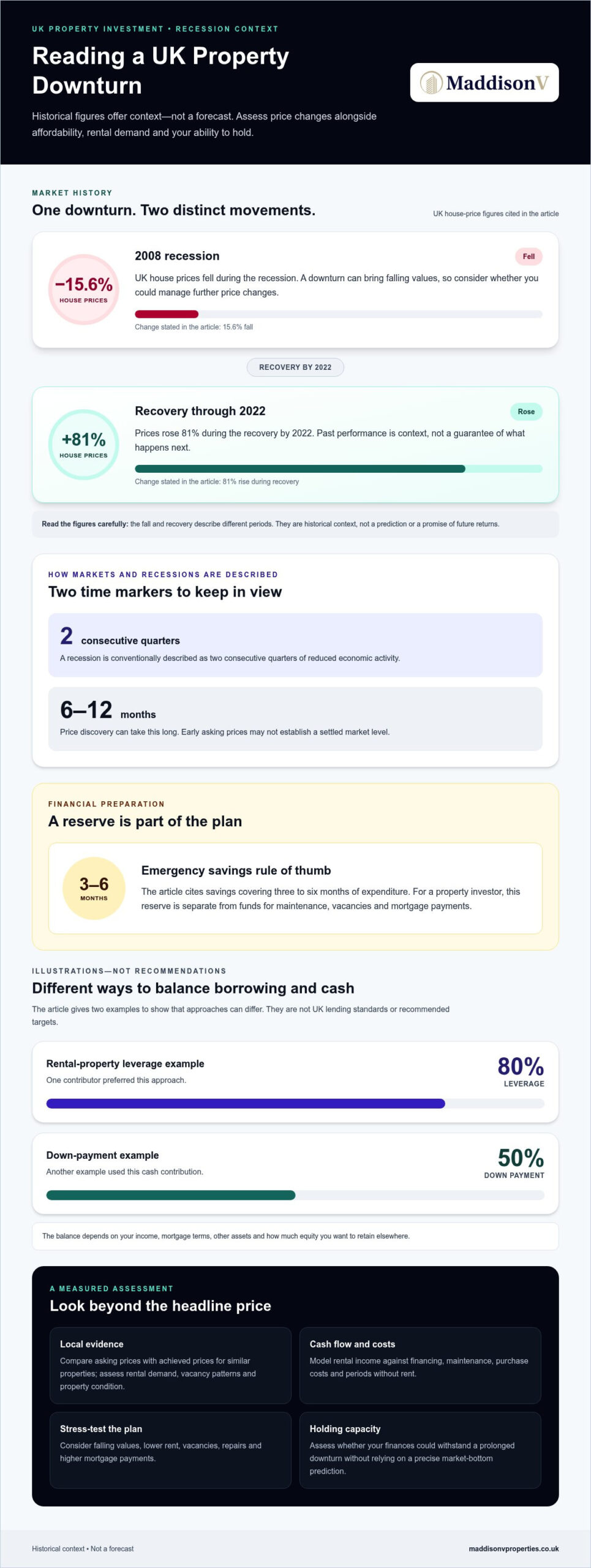
UK house prices fell 15.6% during the 2008 recession, then rose 81% during the recovery by 2022. For anyone investing in property during a UK recession, the lesson is that a downturn can bring both falling values and the potential for later growth. Past performance doesn’t remove the risks, but it offers a useful starting point for assessing them.
It’s understandable to compare property with the relative simplicity of keeping money in the bank. But the right comparison goes beyond headline returns: rental income, costs, borrowing, inflation and how long you can hold the investment all affect the decision.
This article considers five questions to help you assess the choice. You’ll see what previous downturns can and can’t tell you, how to prepare your finances, and how to compare a property’s potential returns with bank interest. The aim is a clear, measured framework for deciding whether a particular investment suits your circumstances, rather than predicting exactly when the market will turn.
Key Takeaways
- Use past downturns as context, not a guarantee; property performance depends on the market, asset type and timing.
- Build a financial plan that accounts for ongoing costs, borrowing and a cash reserve before committing.
- Consider how inflation may affect both property expenses and the real value of rental income over time.
- Stress-test a potential investment against falling values, vacancies and changes in your ability to hold the property.
- Compare a property’s net return with bank interest and other options, taking risk and your own financial goals into account.
1. What makes a real estate recession-proof?
No property is fully recession-proof. UK house prices fell 15.6% during the 2008 recession, then rose 81% during the recovery by 2022. These figures show why investors should assess both short-term price movement and the capacity to hold an asset through recovery. A resilient investment depends on its location, rental demand, financing and the owner’s time horizon.
Past downturns provide context, not a reliable forecast of the next one. For a practical overview of questions investors can consider, watch this video:
A recession is conventionally described as two consecutive quarters of reduced economic activity. Property markets can move on a different timetable: buyers and sellers adjust expectations, while lenders assess their loan portfolios. Price discovery can take 6–12 months, so early asking prices may not establish a settled market level. Falling employment, tighter credit and reduced spending can also affect tenants, sales activity and rental income.
Research the local market before treating a national downturn as a buying signal. Compare recent asking prices with achieved prices for similar properties, then examine rental demand, vacancy patterns and the condition of nearby homes. Consider transport links, employers and planned development in the neighbourhood. A London flat and a property in a smaller town may respond differently to the same economic pressures.
Track the property cycle rather than trying to call its exact bottom. During price discovery, sellers may revise expectations and lenders may reassess risk; later, more settled pricing can reveal which assets remain affordable. The UK’s Covid-19 pandemic recession also showed that prices can rise during a recession: asking prices increased as the government introduced the furlough scheme and a stamp duty holiday. Conditions and policy differed from 2008, so the two periods aren’t interchangeable.
Is it better to buy a buy-to-let, a property fund, or REITs during a UK recession? A buy-to-let gives you direct ownership and rental income, while funds and REITs provide pooled property exposure without requiring you to buy a home directly. Compare control, costs, liquidity and exposure to price changes against your finances and investment approach.
What UK taxes and transaction costs apply to buying an investment property? Include applicable property purchase taxes, conveyancing, surveys and mortgage-related costs in your calculations. Also allow for ongoing ownership expenses and taxes associated with rental income or a future sale.
What due diligence and steps should UK property investors take before buying in a recession? Compare local sales and rental evidence, inspect the property’s condition, and model income against financing and maintenance costs. Keep enough liquidity to manage vacancies or repairs, and consider whether you could hold the investment through further price changes.
Long-term investing means assessing an asset on more than its purchase price. Test whether rental income can cover the costs, whether local demand has durable drivers, and whether your portfolio could withstand a prolonged downturn. For anyone considering investing in property during a UK recession, a disciplined local assessment is more useful than assuming any property type or market will remain unaffected.
2. Financial preparation and mortgage preapproval
Before pursuing a property, clarify your finances and borrowing capacity. Mortgage preapproval can help set a working budget, but it doesn’t replace assessing whether the investment would remain affordable if circumstances changed. For a UK buy-to-let, account for the deposit, mortgage payments, purchase costs, repairs and periods without rental income.
Start with a cash-flow plan. List your income, existing debt and regular expenses, then model the property’s costs alongside likely rental income. A commonly used rule of thumb is to keep emergency savings covering three to six months of expenditure. For a property investor, that reserve is separate from funds for maintenance, vacancies and mortgage payments.
Next, prepare information a lender may use to assess affordability, such as your income, debt commitments, deposit and the property’s expected rental income. Mortgage consultations can help you understand how borrowing costs affect a purchase before you make an offer. A lender’s assessment and your own investment model serve different purposes: approval indicates possible borrowing capacity, while your model tests whether the property fits your plans.
Interest rates affect both monthly costs and the income left after mortgage payments. Borrowing can be costly during a recession, so model how the investment performs with higher payments, lower rent or a vacancy. Don’t base your decision only on the initial rate. Consider what happens when a mortgage deal ends and whether you have enough cash to cover payments during a weaker rental period.
Cash can reduce borrowing and support flexibility, but using all available funds may leave too little for unexpected costs. One contributor preferred rental-property leverage of 80%, while another example used a 50% down payment. These are illustrations of different approaches, not UK lending standards or recommendations. The balance depends on your income, mortgage terms, other assets and the equity you want to retain elsewhere.
Keep borrowing at a level you could manage if the property’s value fell. Lower borrowing can reduce payment pressure, while a larger deposit ties up more capital in one asset. Compare both outcomes with your cash reserve and the role the purchase would play in your portfolio. Preapproval, a stress-tested budget and retained liquidity provide a more considered basis for deciding when to proceed.
For a tailored discussion of borrowing options, mortgage consultations can help you weigh financing against your property plans.
3. Inflation hedging and long-term property investment
Inflation reduces what a fixed amount of money can buy, so investors may consider property as a possible store of value. That doesn’t make every home an effective hedge. A property’s purchase price, rent, borrowing costs and maintenance expenses can each respond differently to economic conditions. Assess them separately before treating inflation protection as an advantage.
Start with the property’s income. Compare current rent with local rents for similar homes, then consider whether demand supports future adjustments. If inflation raises household costs, tenants may have less room for rent increases. A landlord relying on automatic rent growth could instead face longer vacancies or weaker income. Test likely rent against tenant affordability and competing properties.
Rent changes also depend on the tenancy agreement and applicable rules. Review the agreement before assuming when or how much rent can increase. Then compare the current rent with local market evidence and the property’s condition. A well-maintained flat near transport may attract a different tenant profile from a home needing costly repairs or offering limited access. This distinction matters when planning income.
Measure inflation’s effect on both sides of the investment. Rising rents may support income, while higher maintenance, insurance or borrowing costs can reduce what you keep. Build a simple cash-flow model with separate figures for rent, mortgage payments and upkeep. Stress-test it by lowering expected rent and raising expenses. This shows whether the property remains affordable without assuming prices or income will rise.
Long-term ownership can give an investor more time to absorb short-term market movements, but the holding period must suit their finances. Consider whether you could keep the property if resale demand weakened. Assess how much capital would be tied up in one location and property type, too. A diversified portfolio can reduce reliance on a single asset’s performance.
After a period of high inflation, the outlook may involve mild, steady secular inflation over 10–20 years. That possibility isn’t a forecast for property prices or rents. Use it as a reason to consider purchasing power over the full investment horizon. Compare expected rental income and future costs in real terms, rather than judging a projected increase by its cash value alone.
For a practical assessment, record the purchase assumptions, likely rent, recurring costs and planned holding period. Revisit them if local rents, financing or the property’s condition changes. During a downturn, this disciplined review can show whether the investment’s income still supports its role in your plans, or whether your capital would be better placed elsewhere.
4. Real estate investment risks during recessions
A recession can affect property values, rental income and the ability to sell on favourable terms. One contributor estimated that prices could fall by 20–30% in a scenario where sellers seek cash buyers. That figure describes a possible scenario, not a forecast for UK homes. For an investor using a mortgage, falling values can also reduce equity while repayments continue.
Liquidity is a distinct risk. Selling a home takes time, and someone who needs cash quickly may have to accept a lower offer. This illustrates why an investment plan should allow for a longer holding period rather than rely on an immediate resale.
Listed stocks and real estate behave differently under market stress. Shares can be traded frequently, so quoted prices may change rapidly; a property’s value is less visible until a sale or valuation. This can make real estate appear less volatile, but it doesn’t remove the underlying risk. Review recent comparable sales, rental demand and your expected selling timeline before judging an asset’s stability.
Currency movements can also change an overseas investor’s result. One London investor said their property investments were down around 15% in euro terms, even though prices had not technically moved. For an investor measuring wealth in euros, sterling exchange rates can alter the converted value of both rental income and a future sale. Keep the currency of purchase, rent and financial goals in view.
Industrial real estate has its own cycle and tenant risks. Well-positioned, higher-margin, smaller and more agile industrial properties in key markets can remain strong investments, but location and tenant demand still matter. Assess access to transport, suitability for potential occupiers and the cost of keeping the property lettable. The broad label “industrial” alone doesn’t establish resilience.
Before committing, stress-test the investment against specific adverse events: lower rent, a vacant period, unexpected repairs or a delayed sale. Check whether rental income could cover mortgage and operating costs in those circumstances. Consider concentration, too: if several assets rely on the same local employer or tenant type, one economic shock could affect them all. Diversifying property types and regions may reduce exposure to a local downturn, but cannot remove market risk.
For off-plan property, assess its location and purchase terms, and whether you could hold the asset if market conditions weakened. Compare that commitment with an existing property’s rental evidence and condition. Reviewing each risk carefully, rather than assuming one asset class is recession-proof, supports more measured decisions.
5. Comparing investment returns with bank interest
A property’s headline yield doesn’t show what you’ll actually keep. Compare its net income with bank interest after allowing for mortgage payments, maintenance, vacancies and other ownership costs. For example, a flat with regular rent may still deliver a weaker return if repairs or financing absorb much of that income. Compare realistic net outcomes, not advertised rent with a savings rate.
Is investing in UK property during a recession profitable compared with stocks, bonds, or cash? Property may be profitable, but its suitability depends on its costs, income and your financial position. Compare potential income, costs, liquidity and risk with your financial position before choosing.
Use the same starting capital and timeframe for each option. For a property, estimate annual rent after expected running costs, then compare that income with the return available from a savings account or bond. Consider potential changes in property value separately from rental income. This prevents a projected capital gain from obscuring weak cash flow today.
A standard savings account may not keep pace with inflation during a recession. That matters when judging the real purchasing power of interest, rather than its nominal amount. Cash still has a practical role: it remains accessible for emergencies and future opportunities. Keep a reserve for property repairs or vacancies rather than investing every available pound.
Stocks, bonds and commodities involve different exposures. Stock prices can move quickly, while selling a property may take time and involve significant transaction work. Bonds have a different income and price profile; commodities don’t generate rental income. Compare each asset’s likely return with its volatility, accessibility and place in your wider portfolio, rather than ranking investments by one headline figure.
Rental demand shapes the income side of housing investment. Review comparable rents in the property’s area, the condition tenants expect and the costs required to keep the home lettable. Some properties still yield over 10% in sterling terms, but a high gross yield alone doesn’t establish a sound investment. Calculate net yield after costs, then test whether the remaining income compares favourably with bank interest.
For a practical comparison, write down expected net income, possible capital movement, cash tied up and the time needed to sell. Apply the same approach to a savings account, bonds, stocks and commodities. If a property’s return depends on rent increases or price growth, consider how weaker demand could affect those assumptions. Choose an option suited to your liquidity needs and tolerance for income variation.
If you’re assessing a specific opportunity, discuss property sourcing alongside its expected rental income and costs.
MaddisonV Properties: Property Management
MaddisonV Properties provides Property Management for investors who need ongoing oversight after purchasing a rental property. It can help when coordinating tenants, upkeep and day-to-day responsibilities would otherwise fall to you. Facilities Management supports a property’s operational needs, while Portfolio Management helps investors oversee their wider holdings.
If you’re assessing your next purchase, Property Sourcing can help you explore opportunities aligned with your investment goals. The appropriate support depends on where you are in the process, from evaluating a potential asset to managing an established rental. A considered approach helps align property decisions with ongoing oversight.
Contact MaddisonV Properties or visit maddisonvproperties.co.uk to discuss your property investment plans.
Make your next property decision with purpose
A downturn can prompt investors to reconsider what they want property to do for them. Before choosing an asset, define your priorities: reliable rental income, potential long-term growth, or a balance of the two. Use those priorities to decide which compromises are acceptable, from location and property condition to the time and attention ownership requires.
Investing in property during a UK recession involves more than market timing. The question is whether a specific opportunity fits your finances, risk tolerance and plans beyond the current economic cycle. A clear investment brief can turn broad market uncertainty into practical criteria for your next move.
If you’re ready to explore your options, contact MaddisonV Properties to discuss your plans. A thoughtful next step can bring greater clarity to the decision and help you move forward with confidence.
Frequently Asked Questions
What do past recessions tell us?
Past recessions show that property outcomes depend on the downturn’s causes and policy response, not just its label. The 2008 financial crisis involved severe housing and credit pressures, while the Covid-19 recession coincided with government support and a stamp duty holiday. For investors, the practical lesson is to compare the economic conditions behind each episode before using it to guide a purchase today.
What is a property recession?
A property recession is a sustained period of weakness in housing activity. It can involve falling prices, fewer transactions, tighter lending or softer rental demand. It may accompany a wider economic recession, conventionally defined as two consecutive quarters of reduced economic activity, but property cycles don’t always move in step. Track local sales, rents, borrowing conditions and buyer activity together.
What makes a real estate recession-proof?
No asset is entirely protected from a recession. Resilience depends on whether a property can retain tenant demand and cover its costs when household finances or business activity weaken. For example, an investor might compare an essential, well-connected rental home with a premium property reliant on a narrow tenant pool. Assess affordability, alternative local housing and ongoing maintenance needs before investing.
What are the advantages of buying a house in a recession?
A downturn can give prepared buyers more room to negotiate, particularly when a seller prioritises a reliable sale over waiting for a higher offer. It may also allow more time to inspect a home carefully and compare competing properties. The advantage depends on buying at a sound valuation, not simply purchasing because prices have fallen. Keep due diligence and the property’s longer-term use central to your decision.
How do UK property prices and rents typically change during a recession?
Prices and rents don’t necessarily move together or change at the same speed. Sales values may respond to weaker buyer confidence and tighter mortgage availability, while rents depend on local tenant demand, household budgets and available homes. In one neighbourhood, sales activity may weaken before rents soften; elsewhere, rental demand may remain firmer. Compare local evidence for both markets rather than assuming one predicts the other.
Which UK regions and cities offer the best property investment prospects during a recession?
No region is automatically the best choice in every downturn. Compare neighbourhoods by employment diversity, transport access, tenant demand, housing supply and purchase price relative to achievable rent. Even a well-connected city can have areas with very different prospects. Assess the specific property and local rental market, then test whether the investment fits your budget and holding plans.
What are current UK house prices, rental yields, and price-to-rent ratios by region?
These measures vary by location and property type, so use current local sale prices and achievable rents for comparable homes. Calculate gross rental yield by dividing annual rent by the purchase price, then assess net income after ownership costs. The price-to-rent ratio compares a property’s purchase price with its annual rent. Applying the same method across locations makes regional comparisons more useful.
How do UK mortgage rates, lending criteria, and buy-to-let affordability rules affect investors during a downturn?
Higher mortgage interest increases monthly outgoings and can reduce rental income left after financing. Lenders assess affordability using factors such as income, existing commitments, deposit and expected rental income; criteria vary by mortgage product and borrower. Before making an offer, model payments against rent and other costs, including a period without a tenant. This gives you a clearer view of how borrowing affects the investment.

Sign Up Now
Want to read more great articles and blogs subscribe to our newsletter