
What if reinvesting sale proceeds doesn’t automatically defer your property tax? That’s the key difference behind the question of whether there’s a...

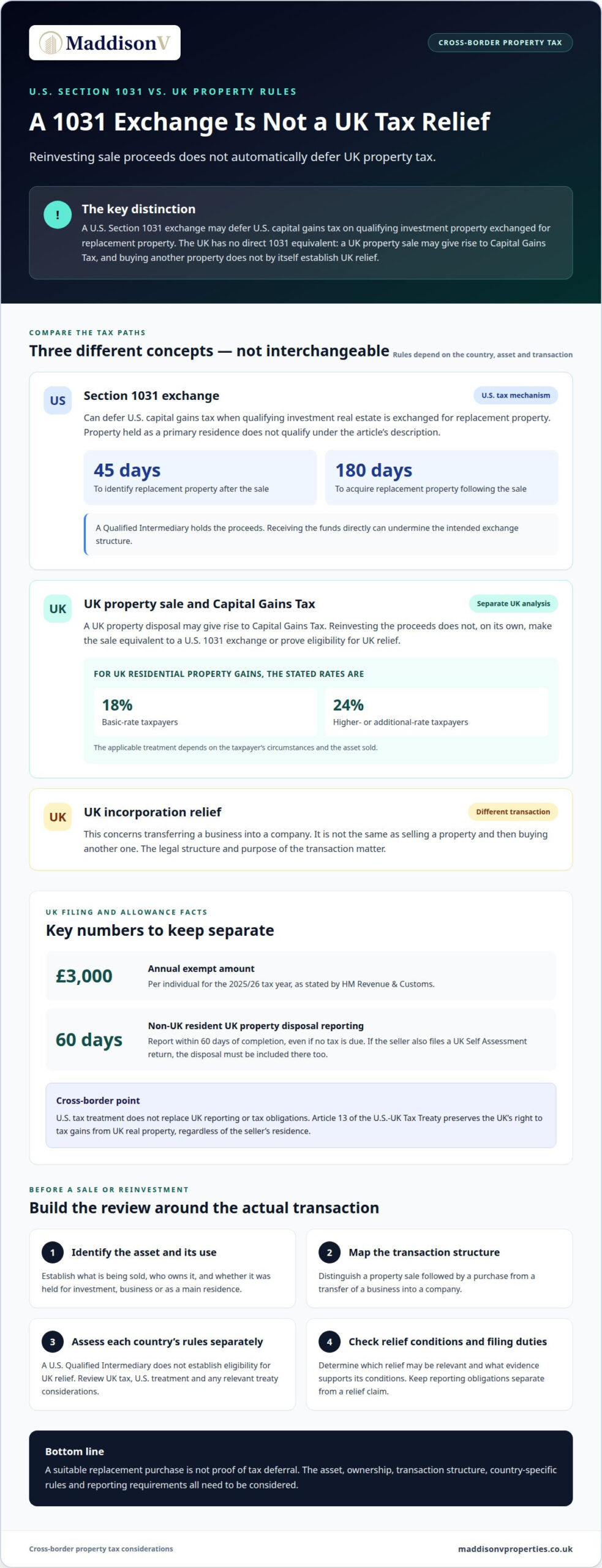
What if reinvesting sale proceeds doesn’t automatically defer your property tax? That’s the key difference behind the question of whether there’s a 1031 exchange equivalent in the UK: there’s no direct UK counterpart to the U.S. mechanism. A U.S. 1031 exchange can defer capital gains tax when qualifying investment property is exchanged for replacement property, while a UK property sale may give rise to Capital Gains Tax.
If you’re comparing the two systems, it’s understandable to look for a familiar way to sell one investment and move into another without an immediate tax bill. This guide explains what a 1031 exchange is, why the UK approach differs, and which tax deferral considerations may matter when UK property is part of a cross-border investment. You’ll also learn about the potential benefits and risks, including the need to distinguish U.S. tax treatment from UK tax obligations. The result is a clearer basis for considering a property sale, reinvestment or portfolio change, without assuming that a U.S. tax strategy carries over to the UK.
Key Takeaways
- A U.S. 1031 exchange and UK tax reliefs are not interchangeable; understand the difference before planning a property sale or reinvestment.
- Find out how qualifying assets, reinvestment conditions and timing can affect access to UK rollover relief.
- See how incorporation relief differs from a 1031 exchange and why transferring a property business involves a separate tax analysis.
- Weigh potential tax deferral against reporting responsibilities and the risks of assuming that a sale automatically qualifies for relief.
Benefits, risks, and professional advice
A U.S. section 1031 exchange can defer tax when qualifying investment property is exchanged for replacement property. There’s no direct 1031 exchange equivalent in the UK, so cross-border investors must consider each country’s rules separately.
Potential Benefits
Tax deferral can preserve more sale proceeds for a qualifying replacement investment, rather than requiring an immediate tax payment. In the United States, a section 1031 exchange can defer capital gains tax when proceeds are reinvested in eligible property. That flexibility may help an investor change property type or adjust an estate’s investment mix while keeping capital invested. Deferral is not the same as tax being permanently eliminated.
Potential Risks
Timing, access to sale proceeds and the replacement purchase can affect whether a U.S. exchange qualifies. The Internal Revenue Service says replacement property must be identified within 45 days and acquired within 180 days following the sale. A Qualified Intermediary holds proceeds during the transaction; receiving the funds directly can undermine the intended exchange structure. Missing a deadline or mishandling proceeds can therefore create a tax liability instead of deferral.
Professional Advice
Cross-border advice matters because U.S. tax treatment does not replace UK reporting or tax obligations. For the 2025/26 tax year, HM Revenue & Customs sets the UK Capital Gains Tax annual exempt amount at £3,000 per individual. For UK residential property gains, the research facts give rates of 18% for basic-rate taxpayers and 24% for higher- or additional-rate taxpayers. The applicable treatment depends on the taxpayer’s circumstances and the asset sold.
Non-UK residents also have a UK reporting step after disposing of UK property. HM Revenue & Customs requires the disposal to be reported within 60 days of completion, even when no tax is due. If the seller also files a UK Self Assessment return, the disposal must be included there too. Coordinating these requirements with a U.S. return can help prevent a missed filing from complicating an otherwise planned sale.
Before selling, bring the transaction structure, ownership details and intended purchase into one review with advisers familiar with both tax systems. For example, a U.S. taxpayer selling UK investment property needs to distinguish UK tax on the property gain from any U.S. tax treatment. Article 13 of the U.S.-UK Tax Treaty preserves the UK’s right to tax gains from UK real property, regardless of the seller’s residence. Advice should therefore address both jurisdictions, the proceeds and the estate’s wider investment purpose.
Capital gains tax deferral
Tax deferral depends on the relief involved, the asset and the transaction, not simply on buying another property. In the UK, a U.S. Section 1031 exchange should not be treated as a ready-made route to defer UK capital gains tax.
Comparing Incorporation Relief and a US 1031 Exchange
UK incorporation relief and a U.S. Section 1031 exchange are different concepts, so their names don’t make them interchangeable. Section 1031 can defer U.S. capital gains tax when qualifying investment real estate is exchanged for replacement property. Incorporation relief concerns a transfer into a company, rather than a straightforward property sale followed by a purchase. The transaction’s legal structure and purpose therefore matter.
For a cross-border owner, the distinction is practical: selling a property and reinvesting the proceeds isn’t automatically equivalent to transferring a business into a company. A U.S. Qualified Intermediary is part of the U.S. exchange process; it doesn’t establish eligibility for UK relief. Treat each country’s tax analysis as a separate part of the transaction.
Qualifying Properties and Assets
Eligibility turns on the specific relief and asset, rather than a general rule that every replacement property qualifies. For U.S. Section 1031, the property must be held for business or investment purposes; a primary residence doesn’t qualify. Different types of real estate may be exchanged if both properties meet those purposes. That U.S. test does not itself decide whether a UK property qualifies for UK relief.
For example, an investor considering a UK rental property and a replacement purchase needs to distinguish the property’s use from its location and ownership. A property held to generate income presents a different picture from a home occupied as a main residence. Those details help frame the tax review, but don’t establish a UK claim on their own.
Claiming Relief on Property and Business Asset Sales
To assess a claim, identify the asset sold, its ownership, the transaction structure and the intended use of any replacement. Then establish which UK relief may be relevant and what evidence supports its conditions. Non-UK residents can’t assume that reinvesting proceeds makes them eligible; UK tax treatment and the relief’s specific requirements must be considered separately.
What steps should UK taxpayers take? Assemble the sale and ownership details, document the proposed transaction, and determine the relevant relief before completing the applicable UK tax filing. HM Revenue & Customs requires non-UK residents to report a UK property disposal within 60 days of completion, even if no tax is owed. That reporting requirement is separate from establishing a relief claim.
Where reinvestment is part of a wider portfolio decision, property sourcing can help shape the search around the investor’s intended asset and investment purpose. Keep that property decision distinct from the tax analysis: a suitable purchase does not itself prove that a relief applies.
Which UK properties and assets qualify for rollover relief?
A property’s location or label alone doesn’t establish eligibility for tax relief. For a UK sale, assess the specific relief, the asset’s use and ownership, and the proposed transaction before treating reinvestment as a way to defer tax.
Start by separating three questions: what was sold, how it was used and what the owner plans to acquire. A London flat held to earn rental income, for example, is used differently from a home occupied by its owner. That distinction helps frame the tax analysis, but neither description alone proves eligibility for rollover relief.
The U.S. Section 1031 rules provide a useful contrast, not a UK eligibility test. In the United States, qualifying real estate must be held for business or investment purposes, and a primary residence doesn’t qualify. Different kinds of real estate can be exchanged when both meet those purposes. Those U.S. conditions cannot be assumed to determine the treatment of a UK property.
UK residence-related relief is another separate concept. Private Residence Relief generally covers the final 9 months of ownership, according to the facts provided, and a qualifying disability or long-term residential care can extend that period to 36 months. These provisions concern a qualifying home, not a general permission to sell one investment property and defer gains by purchasing another.
For a UK property disposal, the owner’s residence status also matters to reporting. HM Revenue & Customs requires a non-UK resident to report a UK property disposal within 60 days of completion, even if no tax is owed. That filing obligation does not itself show that a property or replacement asset qualifies for rollover relief.
Use a structured review before relying on a property’s category:
- Identify the asset: record whether the sale concerns a dwelling, land or another investment asset.
- Describe its use: distinguish personal occupation from rental or business use, using the London flat example where relevant.
- Trace ownership: establish who owns the asset and who will acquire the replacement.
- Name the relief: assess its specific conditions rather than assuming “rollover” applies to every reinvestment.
HM Revenue & Customs sets the Capital Gains Tax annual exempt amount at £3,000 per individual for the 2025/26 tax year. That allowance is not rollover relief and does not decide whether a replacement purchase qualifies. Keep the sale documents, ownership records and evidence of use together; those details give a tax adviser a clear basis to assess the relevant UK treatment.
What are the deadlines and reinvestment requirements for UK rollover relief?
UK property owners shouldn’t assume that reinvesting sale proceeds creates the same timetable as a U.S. Section 1031 exchange. The applicable UK relief and the transaction’s facts determine what deadlines and reinvestment conditions matter.
The U.S. exchange timetable is specific. According to the Internal Revenue Service, replacement property must be identified within 45 days of selling the original property and acquired within 180 days following that sale. These are U.S. Section 1031 deadlines, not UK rollover-relief deadlines. A UK investor considering an American exchange should keep the identification and acquisition dates distinct.
This distinction matters when a UK sale and a U.S. purchase form part of the same investment plan. For example, selling a London rental property doesn’t automatically make a later purchase eligible under either country’s rules. Establish which tax system applies to each disposal and acquisition, then assess the relevant relief’s conditions before treating the proceeds as deferred.
For UK property, the relevant timing can include a reporting obligation rather than a reinvestment window. HM Revenue & Customs requires a non-UK resident to report a UK property disposal within 60 days of completion, even if no tax is owed. That deadline concerns reporting the disposal. It does not mean the owner has 60 days to reinvest, nor does filing alone establish eligibility for rollover relief.
A practical timeline should separate the sale, proposed reinvestment and tax reporting into distinct events. Keep a dated record of the following:
- Sale completion: record the completion date and the owner named in the disposal documents.
- Proposed purchase: note the intended asset, ownership structure and purpose, such as investment or business use.
- Relief assessment: identify the specific UK relief being considered and its conditions before relying on deferral.
- Reporting: for a non-UK resident’s UK property disposal, diarise HMRC’s 60-day reporting deadline.
For instance, an overseas owner selling a UK flat and pursuing another investment should not use the U.S. 45-day identification period as a UK deadline. The owner’s residence, asset use, transaction structure and the relief under consideration all shape the analysis. A purchase plan may support an investment strategy, but it doesn’t itself prove that tax deferral applies.
Before exchanging contracts, coordinate the expected completion date, intended reinvestment and reporting responsibilities. If a U.S. Section 1031 exchange is also being considered, track its 45-day and 180-day periods separately from UK obligations. HMRC’s 60-day reporting rule remains a distinct requirement for non-UK residents disposing of UK property. Clear timelines help prevent a deadline in one jurisdiction from being mistaken for a rule in another.
How does UK incorporation relief compare with a US 1031 exchange?
UK incorporation relief and a U.S. 1031 exchange involve different transaction structures. Incorporation relief concerns transferring a business into a company, while Section 1031 concerns exchanging qualifying investment property. The distinction matters: selling a property and purchasing another is not the same transaction as incorporating a business.
For a U.S. Section 1031 exchange, the investor sells relinquished property and acquires replacement property under specific rules. The Internal Revenue Service sets a 45-day period to identify replacement property and a 180-day period following the sale to acquire it. A Qualified Intermediary holds the proceeds during the transaction. These U.S. requirements do not establish eligibility for UK incorporation relief.
By contrast, incorporation relief is relevant when the plan involves transferring a business to a company, rather than simply replacing one property investment with another. A landlord considering a company structure, for example, must distinguish a business transfer from an individual sale followed by a separate purchase. The asset, ownership and transaction structure shape the analysis; the word “incorporation” alone doesn’t confirm that relief applies.
The intended outcome also differs. Section 1031 can defer U.S. capital gains tax when qualifying investment property is exchanged for replacement property. To defer all capital gains taxes through that exchange, the replacement property must be of equal or greater value than the property sold. That U.S. value condition should not be mistaken for a UK incorporation rule.
Compare the approaches by examining the transaction itself:
- Property exchange: identify the U.S. property sold, replacement property and Section 1031 process.
- Business incorporation: establish whether a business is being transferred into a company, rather than treating a property purchase as an equivalent step.
- Jurisdiction: separate UK tax treatment from U.S. federal tax treatment when a transaction crosses borders.
- Ownership: map who owns the existing asset and who will own the replacement or company-held assets.
For example, a UK-based investor selling a rental property and buying another shouldn’t assume the purchase qualifies for incorporation relief. Transferring a property business into a company is a different structure and requires its own UK tax assessment. U.S. exchange deadlines and replacement-value tests don’t determine whether the UK transfer qualifies.
Keep the investment decision separate from the relief analysis. A property may suit a portfolio’s objectives without creating tax deferral. If you’re considering an investment purchase alongside a wider portfolio decision, explore off-plan investment opportunities as one potential route, while assessing the tax structure separately.
MaddisonV Properties
MaddisonV Properties can help turn a property investment decision into a clear, considered plan. Tax relief eligibility depends on your circumstances and transaction structure, while property sourcing and portfolio management can support decisions about suitable investments and how they fit your wider holdings. Mortgage consultations can also help you understand financing considerations before you proceed with a purchase.
Once you’ve established the tax position with your advisers, property management and facilities management can help with the practical responsibilities of owning UK property. This can be useful when you’re investing from overseas or managing several assets, where oversight and day-to-day operations matter alongside the initial purchase.
For guidance on your UK property investment plans, contact MaddisonV Properties.
Make your next property decision with clarity
Before committing to a sale or purchase, align the investment decision with your wider plans for ownership, location and long-term portfolio direction. The question of a 1031 exchange equivalent in the UK is ultimately a prompt to consider how different tax systems interact with the property strategy you want to pursue. A clear brief can help keep tax advice and investment choices focused on the same outcome.
Set out what you want the next property to achieve, how it fits your existing holdings and which decisions need specialist tax input. This gives you a considered starting point for planning, rather than letting a familiar U.S. approach dictate a UK investment decision. Your circumstances and transaction will shape the right course.
For support with your UK property plans, contact MaddisonV Properties. A thoughtful next step can bring greater confidence to the decisions ahead.
Frequently Asked Questions
What is a 1031 Exchange?
A 1031 exchange is a U.S. tax mechanism that can defer capital gains tax when qualifying investment or business real estate is exchanged for replacement property. Its name comes from Section 1031 of the U.S. Internal Revenue Code. The transaction must follow specific requirements, including using a Qualified Intermediary to hold sale proceeds. It isn’t a general exemption from tax, nor does it apply to a property used as a primary residence.
Does the UK have an equivalent to a US 1031 like-kind exchange?
No, there is no direct 1031 exchange equivalent in the UK. UK tax reliefs have distinct conditions and purposes, so a U.S. exchange structure does not automatically qualify a UK property owner for UK tax deferral. For example, incorporation relief relates to transferring a business into a company, not simply selling one investment property and buying another. The relevant UK treatment depends on the transaction and asset involved.
Can UK property investors defer capital gains tax when selling and buying another property?
Possibly, but buying another property after a sale does not by itself defer UK Capital Gains Tax. The investor must meet the requirements of a specific UK relief; the asset, ownership and transaction structure matter. A landlord selling a rental flat, for example, should not assume that purchasing another rental property automatically qualifies. The tax analysis should identify the relief relied upon and distinguish it from the U.S. Section 1031 process.
What are the tax risks and limits of UK property exchange or reinvestment relief?
The main risk is treating reinvestment as an automatic tax deferral. In a U.S. Section 1031 exchange, the seller’s access to sale proceeds can undermine the exchange, which is why a Qualified Intermediary holds them. Separately, HM Revenue & Customs requires non-UK residents to report a UK property disposal within 60 days of completion, even if no tax is due. A reporting deadline does not establish eligibility for relief.

Sign Up Now
Want to read more great articles and blogs subscribe to our newsletter